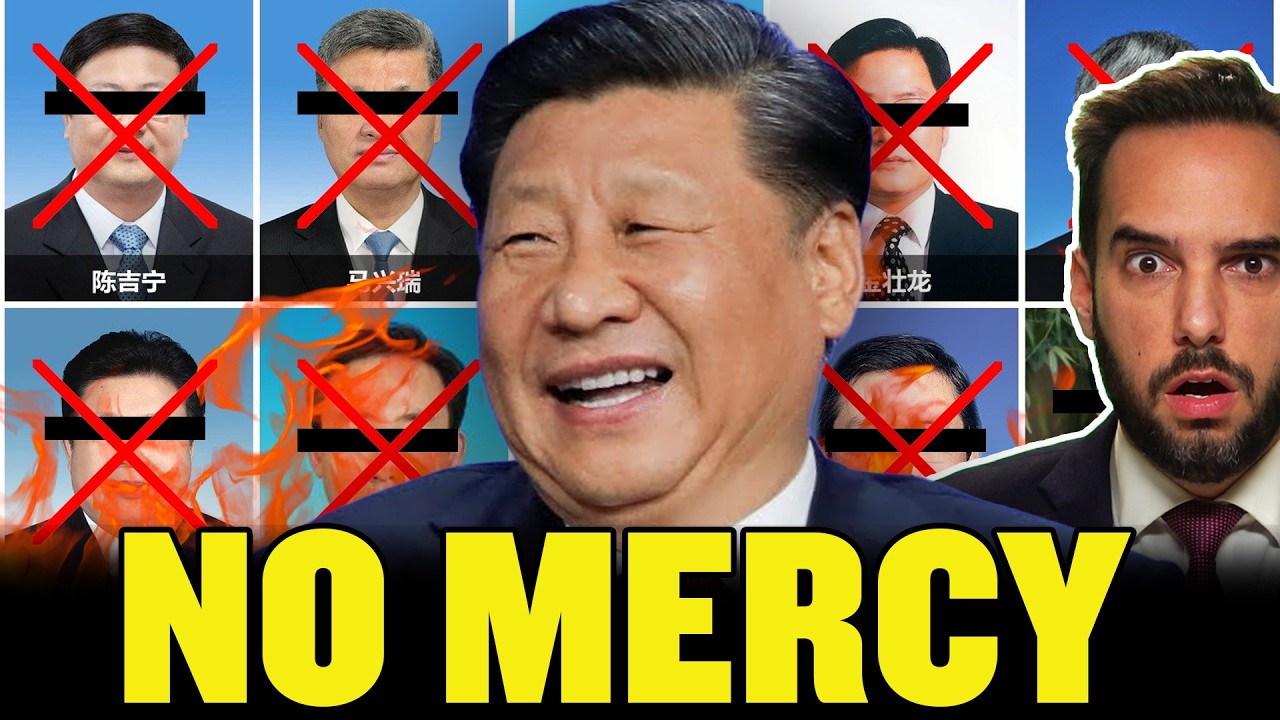
Iran’s decapitation after a massive U.S.–Israel strike is sending shockwaves far beyond the Middle East — all the way to Zhongnanhai. With President Trump’s visit to Beijing just weeks away, the …
Iran’s decapitation after a massive U.S.–Israel strike is sending shockwaves far beyond the Middle East — all the way to Zhongnanhai. With President Trump’s visit to Beijing just weeks away, the timing has major strategic implications. From China’s oil dependence on Iran to broader geopolitical alignments with Russia, Tehran’s crisis could reshape U.S.–China calculations. Is this just a regional conflict or a warning to authoritarian powers? We break down the strategic, economic, and psychological impact of Iran’s decapitation on global dynamics.
This video from Lei's Real Talk examines the geopolitical fallout following a reported massive U.S. and Israel strike on Iran, which has reportedly led to the death of its leadership. The analysis suggests that these events are sending shockwaves far beyond the Middle East, reaching directly into Chinese strategic circles in Zhongnanhai. With President Trump scheduled to visit Beijing shortly after the incident, the timing is presented as having significant implications for international relations.
The content explores how China's heavy reliance on Iranian oil and its broader geopolitical alignment with Russia could be affected by Tehran's crisis. The discussion questions whether this situation represents merely a regional conflict or serves as a warning to other authoritarian powers regarding U.S. military capabilities. The overview covers the strategic, economic, and psychological impacts of such an event on global dynamics. Additional context is drawn from related discussions on historical parallels involving Ming emperors and their relevance to contemporary Chinese leadership concerns. The video aims to break down these complex factors for viewers interested in current affairs and international strategy.
Did China’s reckless actions this week near the Scarborough Shoal nearly activate the Mutual Defense Treaty between the Philippines and United States? On Monday, a Chinese Navy destroyer accidentally rammed a …
Did China’s reckless actions this week near the Scarborough Shoal nearly activate the Mutual Defense Treaty between the Philippines and United States? On Monday, a Chinese Navy destroyer accidentally rammed a Chinese Coast Guard Ship, possibly killing some of their own men. If not for the deft seamanship of the Philippine Coast Guard, however, it appears likely those casualties would have been Filipino. Less than three days later, a Chinese fighter jet flew within 60m of a Philippine plane, while the Chinese Navy shadowed two U.S. ships on a freedom-of-navigation mission near the Shoal. Is it just a matter of time until Beijing stumbles into an armed conflict with Washington? In this episode, we are joined by a new special guest — the former U.S. ambassador to Myanmar — who shares his insights on the latest events in the South China Sea as well as the rising China-U.S. competition for rare earth metals in Myanmar. Host: Yin Khvat Our guests: Alexander Huang Council on Strategic and Wargaming Studies Chair Derek Mitchell Center for Strategic and International Studies (CSIS) Asia Program Non-Resident Senior Advisor Former U.S. Ambassador to Myanmar Former U.S. Department of Defense Deputy Assistant Secretary for Asian and Pacific Security Affairs Chapters: 00:00:00 – China’s Reckless Maritime Behavior 00:01:40 – What If China’s Actions Had Killed? 00:15:02 – Philippine’s Long Seafaring History 00:18:29 – China Seized Scarborough in 2012 00:21:30 – China, U.S. Seek Influence in Myanmar #ScarboroughShoal #IndoPacific #ChineseCoastGuard #ChineseNavy #PeoplesLiberationArmy #PLA #PLANavy #PLACoastGuard #PhilippineCoastGuard #PhilippineNavy #XiJinping #FerdinandMarcosJr #USMilitary #USNavy #PACOM #USSHiggins #MutualDefenseTreaty #PhilippineUSRelations #TaiwanStrait #Myanmar #Burma #RareEarths #RareEarthMinerals #RareEarthMetals #MyanmarChinaRelations #MyanmarCivilWar #USForeignPolicy #TaiwanTalks
This episode of Taiwan Talks examines escalating tensions in the South China Sea, specifically focusing on recent incidents near Scarborough Shoal. The discussion centers on a reported accidental collision between Chinese naval vessels that may have resulted in casualties, followed by an incident where a Chinese fighter jet flew dangerously close to a Philippine aircraft. Additionally, the program addresses reports of Chinese warships shadowing U.S. vessels conducting freedom-of-navigation operations in the region. These events raise questions about whether they could trigger the Mutual Defense Treaty between the United States and the Philippines. The episode features insights from former U.S. Ambassador to Myanmar Derek Mitchell and other strategic experts. They explore the historical context of Philippine maritime rights, China's 2012 seizure of Scarborough Shoal, and the broader competition for influence in Myanmar, particularly regarding rare earth metals. The conversation also touches on the potential risks of armed conflict between Beijing and Washington as geopolitical rivalries intensify. Recorded on August 15, 2025, the program provides a neutral overview of these developing situations without confirming specific casualty numbers or attributing definitive intent to any party involved.
Source: Xiaomi and Huawei EV Fakes Shock the World! 4264 KM in 24 Hours, Car Burns 270 Seconds, No Damage Summary The video titled Xiaomi and Huawei EV Fakes Shock the …
The video titled Xiaomi and Huawei EV Fakes Shock the World! is produced by the China Observer channel. The content focuses on a comparison between electric vehicle models associated with these two major Chinese technology companies. The description highlights that both brands are considered giants in advertising and marketing, engaging in fierce competition to establish themselves as leaders in the automotive sector. This rivalry has resulted in numerous notable instances that have captured consumer attention. The video aims to showcase iconic cases involving these crossover powerhouses, emphasizing their significant market presence. Viewers are invited to explore how these manufacturers vie for dominance in the electric vehicle industry through various demonstrations and comparisons. The presentation seeks to inform audiences about the intensity of the competition between Xiaomi and Huawei regarding their automotive products. No specific technical details or event outcomes are provided beyond the general context of their marketing rivalry and public perception as leading brands in this emerging field.
Rumors exploded across Chinese social media claiming that Zhang Youxia and Liu Zhenli had died in detention. Beijing quickly pushed back — but the signals didn’t stop there. A nationwide “Delta …
Rumors exploded across Chinese social media claiming that Zhang Youxia and Liu Zhenli had died in detention. Beijing quickly pushed back — but the signals didn’t stop there. A nationwide “Delta Action” ad featuring decapitation imagery flooded major cities. Then Xinhua aired a carefully staged “bite the bun” video that many netizens read as dark political satire aimed at Xi Jinping. Coincidence? Or coded messaging in the middle of a high-level power struggle? In this episode, we break down the execution rumors, the symbolism, and the growing information war shaping China’s political atmosphere.
This video from Lei's Real Talk examines recent tensions within China's political landscape, focusing on a series of coordinated events that have sparked public speculation. The episode begins with rumors circulating on Chinese social media suggesting the deaths of officials Zhang Youxia and Liu Zhenli while they were in detention. Beijing authorities quickly issued denials to counter these claims. However, the narrative did not end there. A nationwide advertising campaign known as "Delta Action," which featured imagery of decapitation, appeared simultaneously in major cities. Shortly after, state media outlet Xinhua broadcast a staged video depicting someone biting into a bun, an image that many internet users interpreted as dark political satire targeting President Xi Jinping.
The content explores whether these occurrences were mere coincidences or part of a deliberate information war reflecting a high-level power struggle behind closed doors in Zhongnanhai. The analysis delves into the symbolism present in these events and how they contribute to shaping the current atmosphere in China's politics. By connecting execution rumors with specific visual propaganda, the overview highlights the complex ways in which messaging is used to influence public perception during sensitive political transitions.
00:00 Introduction 00:14 US-China Relations: Strategic Rivalry and Political Uncertainty 07:49 Military Purges: New Report 11:05 Chinese Economy: Consumption Debate Source: China’s Military Purges: Shocking New Details Emerge | US – …
00:00 Introduction 00:14 US-China Relations: Strategic Rivalry and Political Uncertainty 07:49 Military Purges: New Report 11:05 Chinese Economy: Consumption Debate
This video from the independent channel China Update examines recent developments regarding US-China relations, focusing on emerging details about military purges and ongoing economic debates. The content is derived from hundreds of articles, think tank reports, government statements, and resources available in both English and Chinese. The analysis covers strategic rivalry between the two nations and highlights political uncertainty affecting their diplomatic landscape. A significant portion of the discussion addresses a new report concerning internal military actions within China, providing context on these shifting dynamics without guaranteeing absolute accuracy for all claims made. Additionally, the overview explores the current state of the Chinese economy, specifically centering on the debate surrounding consumption patterns. Viewers are encouraged to verify information independently and consult professionals before making investment decisions, as the channel explicitly states it does not offer financial advice. The video aims to deliver up-to-date geopolitical news and analysis while maintaining full editorial independence from external influences or funding sources beyond direct viewer support.
Americans lose an estimated $10 billion a year to Chinese crypto fraud schemes. U.S. authorities say they are working to seize and return stolen funds linked to scams run by transnational …
Americans lose an estimated $10 billion a year to Chinese crypto fraud schemes. U.S. authorities say they are working to seize and return stolen funds linked to scams run by transnational criminal organizations tied to the Chinese Communist Party (CCP). Three Chinese scientists are now off the hook after authorities in Beijing intervened in an alleged biological smuggling case in the United States.
This episode of China in Focus examines the significant financial impact of Chinese-linked cryptocurrency fraud on Americans, with authorities estimating annual losses at ten billion dollars. U.S. officials state they are actively working to seize and return funds stolen by transnational criminal organizations connected to the Chinese Communist Party. The program also reports that three Chinese scientists have been cleared following intervention from Beijing in an alleged biological smuggling case involving worms. Additionally, investigations reveal stories of children born via surrogacy in California centers operated by Chinese nationals, noting there are at least one hundred such facilities where these individuals were raised and may now be eligible to vote.
Geopolitical tensions are highlighted through China's urging its citizens to leave Iran amid looming military conflict and fading diplomatic hopes. The report details Beijing's waning influence in South America, specifically Panama forcing a Hong Kong company out of the canal. A new book titled Killed to Order is discussed, exposing allegations of forced organ harvesting linked to the Chinese Communist Party over two decades. The episode further covers sentencing for a Hong Kong activist's father and an incident involving Cuba and a U.S. boat.
For the first time, a local company is laying an undersea cable connecting Taiwan’s main island to the outlying Matsu islands. The project comes after the Matsu cables were severed over …
For the first time, a local company is laying an undersea cable connecting Taiwan’s main island to the outlying Matsu islands. The project comes after the Matsu cables were severed over 20 times in the past five years, most notably in 2023 when Chinese ships cut both lines, leaving 13,000 residents without internet for 50 days.
Taiwanese firm has undertaken the historic task of laying an undersea cable to connect the main island with the outlying Matsu islands for the first time. This initiative follows a period of significant disruption, where existing cables connecting the region were severed more than twenty times over the last five years. The most severe incident occurred in 2023 when Chinese vessels cut both lines simultaneously. That event left approximately 13,000 residents without internet access for fifty days, highlighting the vulnerability of the current infrastructure.
The project aims to restore reliable connectivity and prevent future outages caused by repeated severing incidents. By establishing a new direct link, the local company hopes to improve communication stability for the Matsu population. The report was produced by TaiwanPlus News, which focuses on presenting unique perspectives on both local issues and global events. The video runs for roughly two minutes and features reporting by Dolphine Chen and Chris Gorin. This development marks a significant step forward in addressing the chronic connectivity challenges faced by the island community amidst ongoing regional tensions.
Japan says it plans to deploy surface-to-air missiles on Yonaguni Island by 2030, just 110 kilometers from Taiwan. TaiwanPlus spoke to Professor Tsai Hsi-hsun from Tamkang University for more on what …
Japan says it plans to deploy surface-to-air missiles on Yonaguni Island by 2030, just 110 kilometers from Taiwan. TaiwanPlus spoke to Professor Tsai Hsi-hsun from Tamkang University for more on what this could mean moving forward.
Japan has announced plans to deploy surface-to-air missiles on Yonaguni Island by the year 2030. This location is situated approximately 110 kilometers from Taiwan, placing it in close proximity to the island nation. The report highlights this strategic development as a significant move that could influence regional security dynamics in the coming years. To provide further context regarding the implications of this deployment, TaiwanPlus News interviewed Professor Tsai Hsi-hsun from Tamkang University. The discussion aims to explore what these changes might mean for future interactions and stability in the area. Produced by reporters Kris Ma and Lery Hiciano, this segment is part of TaiwanPlus News coverage which focuses on local issues as well as global events affecting the region. The channel presents a unique perspective on world affairs, offering viewers insights into how such military adjustments could shape the geopolitical landscape between Japan, Taiwan, and their neighbors. This overview relies solely on the provided information without adding external details or interpretations beyond what was reported.
Source: Finding Rare Earths in Japanese Mud | | Peter Zeihan Summary This video from the channel Zeihan on Geopolitics, hosted by Peter Zeihan, explores the topic of locating rare earth …
This video from the channel Zeihan on Geopolitics, hosted by Peter Zeihan, explores the topic of locating rare earth elements within Japanese soil. The segment is part of a broader discussion on geopolitical resources and their strategic importance. At 282 seconds in length, the content focuses specifically on the potential presence of these critical minerals in mud deposits found in Japan. The presentation aims to inform viewers about where such valuable materials can be sourced, highlighting Japan's specific geological context regarding rare earth extraction.
The video serves as an educational resource for those interested in understanding global supply chains and mineral distribution. It does not provide a transcript or detailed technical analysis beyond the general premise of finding these elements in Japanese mud. Viewers are directed to external links for further engagement, including a Patreon page, newsletter subscriptions, podcast episodes, and social media platforms like Twitter, LinkedIn, Instagram, and Facebook. The description also mentions purchasing webinars through a dedicated Shopify store. No specific quotes or detailed conclusions are presented within the provided text, leaving the core narrative focused on the initial premise of resource location in Japan.
Source: They’re preparing for another war Summary The video titled They're preparing for another war, produced by the Geopolitical Economy Report, examines shifting dynamics in the Asia-Pacific region. The public description …
The video titled They're preparing for another war, produced by the Geopolitical Economy Report, examines shifting dynamics in the Asia-Pacific region. The public description suggests that the United States is currently engaged in a new cold war against China while attempting to enlist other nations in the region to support this stance. In contrast, Vietnam is reportedly refusing participation in these efforts and instead formulating plans for a potential second conflict with the United States. The content aims to explain the intricate geopolitical landscape of Southeast Asia and outlines what the description characterizes as the strategic approach of the US empire. The segment runs for approximately three minutes and focuses on how regional powers are navigating external pressures. Viewers are invited to explore further details through associated newsletters or support channels mentioned in the video metadata. The report does not provide specific dates, direct quotes, or additional event details beyond these core assertions regarding international relations and strategic positioning among key nations in the area.
Peru’s president Jose Jeri has been ousted over a growing Chinese scandal. And with the Chinese fishing fleet massing around Peru’s waters, the question is becoming—has China already invaded? Source: China …
Peru’s president Jose Jeri has been ousted over a growing Chinese scandal. And with the Chinese fishing fleet massing around Peru’s waters, the question is becoming—has China already invaded?
The video titled China Invaded and A President Falls, produced by the channel China Uncensored, examines recent geopolitical developments involving Peru and China. The public description highlights that Peruvian President Jose Jeri has been ousted amid a growing scandal linked to Chinese interests. Simultaneously, reports indicate a significant massing of Chinese fishing fleets around Peruvian waters, prompting questions about whether this constitutes an invasion. The content suggests these events are connected under the label Operation Honey Pot.
The video aims to inform viewers about these unfolding situations and encourages engagement through comments and subscriptions. It directs audiences to external resources such as a newsletter, mobile app, and social media platforms for further updates on China-related news. The description also promotes a free two-day AI mastermind event with bonuses, though this appears separate from the main geopolitical narrative. Overall, the material presents a scenario where political instability in Peru coincides with increased Chinese maritime presence, leaving the nature of these actions open to interpretation by the viewer.
Four weeks after Xi Jinping moved against his two most powerful generals, Beijing remains locked in a dangerous stalemate. No official charges. No confirmed detention site. Not even confirmation of whether …
Four weeks after Xi Jinping moved against his two most powerful generals, Beijing remains locked in a dangerous stalemate. No official charges. No confirmed detention site. Not even confirmation of whether Zhang Youxia is still alive. As rumors swirl and red aristocratic families demand answers, the CCP’s silence itself has become the crisis. This episode breaks down why Xi’s camp can’t “produce” Zhang Youxia, how using public security to seize military leaders humiliates the PLA, and why elites are starting to build their own protection networks—an early warning sign of systemic breakdown inside the regime.
Four weeks after President Xi Jinping targeted two of his most senior generals, Beijing finds itself in a precarious stalemate regarding the fate of Zhang Youxia. Official charges remain unissued, detention locations are unconfirmed, and there is no verification of whether Zhang is still alive. Amidst swirling rumors and demands from powerful families for answers, the Communist Party's silence has effectively become the central crisis. This episode examines why Xi's leadership team cannot publicly produce Zhang, analyzing how utilizing public security forces to detain military leaders potentially humiliates the People's Liberation Army. The discussion also explores why political elites are reportedly constructing their own protective networks, suggesting an early warning sign of systemic instability within the regime. The video further contextualizes current events by drawing parallels between a Ming Emperor's historical death and contemporary challenges facing China. Produced by Lei's Real Talk, this content focuses on world economy, history, and politics with a primary emphasis on U.S.-China relations, aiming to reveal hidden stories behind major geopolitical shifts.
With the Fujian ship (Type 003) joining the fleet and undergoing intensive sea trials, both official media and online communities have entered an unprecedented “Three Aircraft Carrier Era” frenzy. In carefully …
With the Fujian ship (Type 003) joining the fleet and undergoing intensive sea trials, both official media and online communities have entered an unprecedented “Three Aircraft Carrier Era” frenzy. In carefully edited promotional videos, set to dramatic music and slow-motion shots, and with overwhelming praise proclaiming “far ahead,” an inflated strategic illusion is spreading: it seems that as long as these three steel giants line up in the Western Pacific, America’s half-century of naval dominance will instantly vanish.
The video titled China's 3 Carriers Combined Can't Beat U.S. Nimitz—Only 60 Sorties vs. Nimitz's 240 is presented by the channel China Observer and runs for approximately fourteen minutes and thirty seconds. The content addresses the recent entry of the Fujian ship, designated as Type 003, into service alongside ongoing sea trials. This development has sparked significant interest among official media outlets and online communities, leading to a surge in enthusiasm often described as an unprecedented frenzy regarding a so-called Three Aircraft Carrier Era.
Promotional materials frequently utilize dramatic music, slow-motion imagery, and enthusiastic commentary to suggest that China's naval capabilities have surpassed previous benchmarks. These presentations aim to convey the impression that the presence of three large aircraft carriers in the Western Pacific would immediately diminish American naval dominance accumulated over fifty years. The video challenges this narrative by contrasting operational sortie numbers, specifically comparing the combined sortie capacity of China's three carriers against that of a single U.S. Nimitz-class carrier. The description notes that while public perception is inflating strategic illusions through edited content, the actual operational disparity remains significant. The channel invites viewers to support independent news reporting and provides contact information for business inquiries, maintaining a focus on analyzing these naval developments without inventing specific tactical outcomes or quotes not found in the provided source material.
In China, new players in energy storage, virtual power plants and smart microgrids are helping develop and expand the country’s new energy market. Officials from China Southern Power Grid say the …
In China, new players in energy storage, virtual power plants and smart microgrids are helping develop and expand the country’s new energy market. Officials from China Southern Power Grid say the total access capacity connected to virtual power plants exceed 14 million kilowatts.
This brief overview from ShanghaiEye highlights how China is advancing its artificial intelligence capabilities through significant investments in new energy infrastructure. The video focuses on the roles of emerging players within the sector, specifically virtual power plants and smart microgrids, which are essential for expanding the nation's renewable energy market. According to officials from China Southern Power Grid, the total access capacity connected to these virtual power plants has surpassed 14 million kilowatts. This substantial growth demonstrates a concerted effort to integrate advanced storage solutions with modern grid technologies. By leveraging these innovations, the country aims to support its technological development while managing energy demands more efficiently. The content serves as an introduction to these specific developments within the broader context of China's evolving power landscape. Viewers are directed to additional playlists covering current events in Shanghai, local culture, post-pandemic life, and perspectives from foreign scholars. The channel emphasizes its commitment to delivering high-quality content about the city and encourages subscriptions for further updates on regional news and stories.
Source: China’s AI Slop is Hilarious! Summary The video titled China's AI Slop is Hilarious! from the channel China Fact Chasers offers a comparative look at situations between China and the …
The video titled China's AI Slop is Hilarious! from the channel China Fact Chasers offers a comparative look at situations between China and the West. Hosted by individuals who have lived in China for an extended period, the program takes viewers on weekly bike rides to explore new locations while addressing specific topics and audience inquiries. The episode focuses on artificial intelligence content generated within China, presenting examples that the creators find amusing. This segment aims to shed light on current developments through direct observation and comparison rather than relying solely on external reports.
The production is supported by various platforms including Patreon and PayPal, with additional community engagement occurring on Reddit and Facebook. Musical credits are given to a specific track used in the video. The content draws upon a range of external sources covering diverse subjects such as legal cases, intelligence activities, trade relations, and university rankings. These references provide context for the broader discussion on international dynamics and technological advancements. The overall tone seeks to inform viewers about these complex issues through personal experience and curated information available from public records and news outlets.
With Trump’s “liberation day” tariffs struck down, the ratification of Taiwan’s trade pact with the US faces new challenges. TaiwanPlus spoke to economist Dachrahn Wu, head of the Taiwan Economic Development …
With Trump’s “liberation day” tariffs struck down, the ratification of Taiwan’s trade pact with the US faces new challenges. TaiwanPlus spoke to economist Dachrahn Wu, head of the Taiwan Economic Development Research Center at National Central University, to learn more. Wu says key semiconductor exports are protected and warns that reopening talks could backfire, adding that US–China talks will likely focus on security over trade, with limited impact on Taiwan. 📹 Reporter(s): Patrick Chen/Ai Chi #TaiwanPlus #TaiwanPlusNews #TaiwanNews –
TaiwanPlus News presents an analysis regarding the shifting landscape of trade relations between Taiwan and the United States. Following the legal overturning of former President Trump's so-called "liberation day" tariffs, the ratification of a proposed trade pact encounters fresh obstacles. The segment features commentary from economist Dachrahn Wu, who leads the Taiwan Economic Development Research Center at National Central University. According to Wu, critical semiconductor exports remain protected under current arrangements. He cautions that restarting negotiations could produce unfavorable outcomes for the region. Furthermore, the discussion suggests that future dialogues between Washington and Beijing will primarily center on security matters rather than commercial issues, limiting their direct impact on Taiwan's specific trade interests. The report highlights these developments as key factors influencing the economic outlook amidst ongoing political uncertainty.
Should Taiwan seek to join a mutual defense alliance with neighboring nations? How might Taipei fulfill such a role, while avoiding a direct provocation of Beijing? Watch our discussion and share …
Should Taiwan seek to join a mutual defense alliance with neighboring nations? How might Taipei fulfill such a role, while avoiding a direct provocation of Beijing? Watch our discussion and share your thoughts below.
The video titled Should a Hypothetical Asian NATO Include Taiwan is produced by the channel Taiwan Talks and runs for approximately five minutes. The content explores whether Taiwan should pursue membership in a mutual defense alliance with neighboring countries. It examines how Taipei might effectively fulfill such a role within a broader regional framework. A central focus of the discussion involves strategies to avoid direct provocation of Beijing while still establishing security partnerships. The presentation invites viewers to consider the complexities of integrating Taiwan into an alliance structure without escalating tensions with mainland China. The description suggests that the conversation addresses both the feasibility and the potential risks associated with such a move. By analyzing these factors, the video aims to provide insight into current geopolitical dynamics in the Asia-Pacific region. It encourages audience engagement through comments, allowing for diverse perspectives on the topic of regional security cooperation involving Taiwan.
00:00 Intro 00:46 Unpacking China’s Mineral War, Global Response: Expert 01:25 Significance Of Rare Earth Minerals 03:53 Alliance Secures Rare Earth Supply Chains 05:49 How Did China Become The Dominant Player? …
00:00 Intro 00:46 Unpacking China’s Mineral War, Global Response: Expert 01:25 Significance Of Rare Earth Minerals 03:53 Alliance Secures Rare Earth Supply Chains 05:49 How Did China Become The Dominant Player? 09:45 Why Beijing Fixates On Rare Earth Metals 10:30 Green Tech Boom Hinges On Mineral Supply 12:08 Global Security And Competition For Critical Minerals 12:34 Mining Is Ugly, But The West Needs It 14:49 Clean Tech Isn’t Really Clean 16:19 Critical Minerals To Shape The Next War 17:59 To Cut Reliance On China, Follow The Money 19:25 Japan Turns To Deep Sea Mining For Minerals
This video from the China in Focus channel examines the strategic importance of rare earth minerals, which are essential for manufacturing consumer electronics, vehicles, microchips, and military equipment. The program highlights that while these materials power modern technology, China currently dominates global processing capacity. An expert interview explores how this dominance shapes economic security and military strength worldwide.
The discussion covers the historical factors that allowed Beijing to become the leading player in this sector and analyzes why Chinese authorities prioritize control over these specific metals. The segment also addresses the environmental costs associated with extraction, noting that clean technology relies heavily on mineral supplies that are not always environmentally friendly. Furthermore, the overview touches upon international efforts to secure alternative supply chains, including alliances formed to reduce dependency on a single nation.
Additional topics include Japan's exploration of deep sea mining as an alternative source and the potential role these resources will play in future conflicts. The program aims to provide context on how critical minerals influence global competition and why Western nations must address their reliance on current suppliers to ensure long-term stability and security.
At a global disarmament conference in Geneva, the United States accused China of secretly conducting low-yield nuclear tests in 2020 — an allegation Beijing strongly denies. The claim comes at a …
At a global disarmament conference in Geneva, the United States accused China of secretly conducting low-yield nuclear tests in 2020 — an allegation Beijing strongly denies. The claim comes at a pivotal moment, as the New START treaty between the US and Russia has expired and Washington pushes for a new trilateral arms control framework that China refuses to join. Are we entering a post–arms control era marked by renewed nuclear testing and unconstrained warhead deployments? In this episode, we examine the credibility of the US allegations, China’s strategic calculus, the collapse of traditional arms control regimes, and what a potential three-way nuclear competition could mean for the Indo-Pacific and Taiwan. *Recorded on February 12, 2026 at 3:15pm Taiwan Standard Time Host: Wen-Ti Sung Producer: Chinyeh Chiang Our guests: Kitsch Liao Atlantic Council’s Global China Hub Associate Director K. Tristan Tang Pacific Forum Non-Resident Vasey Fellow Chapters: 00:00:00 – Talks Falter as US-Russia Treaty Expires 00:01:40 – US Accuses China of Secret Nuke Tests 00:09:00 – New START Treaty Lapses 00:14:00 – US Calls for Treaty With Russia, China
Panama has formally terminated contracts that gave Hong Kong company CK Hutchison the rights to operate the ports at either end of the Panama Canal. It was set to keep doing …
Panama has formally terminated contracts that gave Hong Kong company CK Hutchison the rights to operate the ports at either end of the Panama Canal. It was set to keep doing so until 2047, but a ruling by Panama’s supreme court in January annulled the contracts. Beijing has warned of “heavy prices” to pay for the cancellation. 📹 Reporter(s): Fuhua Hung/John Van Trieste #TaiwanPlus #TaiwanPlusNews #TaiwanNews –
China’s global image of strength—built on growth, infrastructure, and military spectacle—masks a system shaped by state control, distorted data, and strategic propaganda, raising urgent questions about how democracies should assess Beijing’s …
China’s global image of strength—built on growth, infrastructure, and military spectacle—masks a system shaped by state control, distorted data, and strategic propaganda, raising urgent questions about how democracies should assess Beijing’s real power to avoid costly strategic miscalculation.
China—along with other countries around the globe—is facing a new 15 percent tariff on all goods exported to the United States. That’s on top of industrial tariffs President Donald Trump imposed …
China—along with other countries around the globe—is facing a new 15 percent tariff on all goods exported to the United States. That’s on top of industrial tariffs President Donald Trump imposed last year. Trump says China will benefit if the Supreme Court rules against his birthright citizenship order. The court is set to consider the issue in April. Fake news sites tied to the Chinese Communist Party are the subject of a new report, which says a China-linked network is impersonating major U.S. media outlets. It’s targeting a New York performing arts company founded by victims of persecution under communism. An event in Nashville highlights the challenges Christian communities are facing worldwide and how believers are responding. Sam Brownback, former U.S. ambassador-at-large for International Religious Freedom, said: “China’s at war with God. They will not win this war, but they could cause a lot of death and carnage 00:00 Intro 01:09 How Trump’s 15% global tariff will impact chinese goods 04:03 Trump: Any Change to Birthright Rule Could Help China 04:51 Report: CCP-Linked Fake Sites Mimic Major Media Outlets 07:40 Faith Groups Highlight Work Against Religious Persecution 10:24 India Joins Pax Silica to Challenge China’s Technology Sector 12:15 Trump Raises Global Tariffs From 10 Percent to 15 Percent | Analysis 🔵Tiffany Meier’s documentary Hollywood Takeover – how Beijing is rewriting the script in America’s film industry: hollywoodtakeover.com
China Update provides the most up to date political, economic, and geopolitical news and analysis on China. Videos are based on hundreds of articles, think tank reports, government statements and other …
China Update provides the most up to date political, economic, and geopolitical news and analysis on China. Videos are based on hundreds of articles, think tank reports, government statements and other resources in English and Chinese. China Update is fully independent and I make the videos. X (Formerly Twitter): / tonychinaupdate Channel email: [email protected] 00:00 Introduction 00:17 US-China: Trump Visit & Taiwan Trade 04:32 China Investors Embrace AI Rally 07:21 China’s Auto Sector Slump
This video exposes the hidden wealth empire of Xi Jinping’s family, shattering the official narrative of clean leadership. Despite claims since 2012 that relatives exited business, evidence shows no real severance—instead, …
This video exposes the hidden wealth empire of Xi Jinping’s family, shattering the official narrative of clean leadership. Despite claims since 2012 that relatives exited business, evidence shows no real severance—instead, assets moved into shadowy proxies and shell companies. Xi’s sister Qi Qiaoqiao quietly dominates lucrative sectors: Venezuelan oil deals netting billions annually via special quotas, rare earth monopolies in Jiangxi, concrete supply in Shenzhen-Guangzhou, and deep ties to China Ping An Insurance. Estimated family-controlled assets exceed 20 trillion RMB (~$3 trillion USD). The script details money-laundering via white glove Chen Zhi, whose 127,271 Bitcoin ($15 billion) and London properties were seized by US-UK authorities in 2026. His repatriation to China is portrayed as silencing to protect the family. Ultimately, the decade of “anti-corruption” is framed as a brutal wealth centralization, turning national resources into one family’s private fortune—while ordinary people pay the price.
Since Xi Jinping’s arrest of Zhang Youxia, the second-highest-ranking military official, and General Liu Zhenli, the military has been in turmoil. A video uploaded by X users claims that an explosion …
Since Xi Jinping’s arrest of Zhang Youxia, the second-highest-ranking military official, and General Liu Zhenli, the military has been in turmoil. A video uploaded by X users claims that an explosion occurred at a Chinese military facility in Zibo, Shandong on February 21. This incident is reportedly connected to dissatisfaction with Xi within the military.
China has amassed vast “floating barriers” – stretching at least 200 miles – mobilising thousands of fishing vessels in a new threat to Taiwan.An animation created using ship-tracking data shows around …
China has amassed vast “floating barriers” – stretching at least 200 miles – mobilising thousands of fishing vessels in a new threat to Taiwan.An animation created using ship-tracking data shows around 1,400 boats gathering in the East China Sea, in two recent operations that went largely undetected until now.Maritime analysts have warned that “a formation of this size and discipline has never been seen before.”The boats are seen forming wall-like parallel or L-shaped lines so dense, that some approaching cargo ships appeared to skirt around them or had to zigzag through.Such formations serve as a display of maritime coordination or a potential “gray-zone” blockade, known to be part of China’s harassment playbook at sea.
The Fujian aircraft carrier has officially joined the fleet. Since crossing the Taiwan Strait in December 2025, it has resumed its maritime training exercises. Expectations are high for its performance in …
The Fujian aircraft carrier has officially joined the fleet. Since crossing the Taiwan Strait in December 2025, it has resumed its maritime training exercises. Expectations are high for its performance in this new round of training, with hopes of uncovering fresh highlights.Chinese military experts are also paying close attention. After carefully analyzing the latest official video, the results may disappoint some. They found that Fujian’s performance in this exercise showed no new breakthroughs and, in fact, highlighted some ongoing issues, with a few even becoming more evident.
Taiwan’s Cabinet says it will continue safeguarding the country’s industries and maintaining steady economic development as US tariff policy shifts. US President Donald Trump on Friday imposed a sweeping 10% global …
Taiwan’s Cabinet says it will continue safeguarding the country’s industries and maintaining steady economic development as US tariff policy shifts. US President Donald Trump on Friday imposed a sweeping 10% global tariff to replace measures struck down by a US Supreme Court ruling, while the White House signaled some tariffs would be ended. 📹 Reporter(s): TaiwanPlus#TaiwanPlus #TaiwanPlusNews #TaiwanNews-
After the downfall of Zhang Youxia and Liu Zhenli, Xi Jinping hasn’t left Beijing for three months — breaking his New Year tradition of visiting frontline troops. Instead, he inspected the …
After the downfall of Zhang Youxia and Liu Zhenli, Xi Jinping hasn’t left Beijing for three months — breaking his New Year tradition of visiting frontline troops. Instead, he inspected the PLA by video from a heavily guarded hall, surrounded by only two senior figures. The empty optics and strange seating hinted at fear at the top. Then came a shock: the high-profile return of a once “politically radioactive” military seductress on CCTV platforms. This episode unpacks the body language, the staged visuals, and why her comeback sends a message Xi can’t ignore.
A Chinese company has been forced to sell land near a U.S. military site—a win for Utah’s government.Marrying U.S. military members to gain base access appears to be another Beijing-linked scheme. …
A Chinese company has been forced to sell land near a U.S. military site—a win for Utah’s government.Marrying U.S. military members to gain base access appears to be another Beijing-linked scheme. Lawsuits and arrests are underway.The CIA takes action: A Mandarin recruiting video targets Chinese officers after a rare military purge sparks backlash. The video says, “Anyone with leadership qualities is bound to be subject to suspicion and ruthlessly eliminated.”The United States and Taiwan have struck a trade deal—bolstering the island nation’s defense against Beijing’s threats.Japan seizes a Chinese fishing boat and arrests its captain, and China protests.China is also helping Russia sidestep U.S. sanctions, with tens of thousands of cars exported through China.00:00 Intro01:01 Utah forces Chinese Company to sell land01:44 Phony marriages for U.S. military base access04:02 CIA video recruiting Chinese officers as spies05:49 U.S. warns on China’s deals in Venezuela07:39 A declining China‑Venezuela relationship08:26 U.S.‑Taiwan reach reciprocal trade deal10:35 New NATO Arctic mission to defend against Russia, China11:07 Japan seizes Chinese fishing boat, arrests skipper11:41 2 Chinese nat’ls charged with spying on Buddhist group12:52 Foreign cars flow into Russia via China14:41 China deal offers zero tariffs to S. African exports15:12 Lessons from China’s Cultural Revolution: Xi van Fleet
China’s annual “Two Sessions” are set to open in early March, offering a critical glimpse into Beijing’s political priorities, economic direction and approach to Taiwan. This year’s meetings unfold amid exceptional …
China’s annual “Two Sessions” are set to open in early March, offering a critical glimpse into Beijing’s political priorities, economic direction and approach to Taiwan. This year’s meetings unfold amid exceptional uncertainty, following the dramatic purge of senior PLA leaders including Vice Chairman Zhang Youxia, raising questions about civil–military relations and internal stability. At the same time, China is entering its 15th Five-Year Plan period, with growth targets, defense spending, and industrial policy under intense scrutiny. How will Beijing balance political control, economic strain, and mounting external pressure from Washington? In this episode, we preview the Two Sessions, examine key political and economic signals to watch, and assess what shifts in rhetoric may reveal about China’s intentions toward Taiwan and the evolving US–China relationship. *Recorded on February 6, 2026 at 2pm Taiwan Standard Time Host: Wen-Ti SungProducer: Chinyeh Chiang Our guests: Titus Chen National Chengchi University Institute of International Relations Research Professor and Deputy DirectorWei-Feng Tzeng National Chengchi University Institute of International Relations Associate Research Fellow Chapters:00:00:00 – China Launches New 5-Year Plan amid Purges00:02:36 – China Loses Military Expertise in Latest Purges00:11:34 – Beijing’s Five-Year Plan Clings to 5% GDP Goal00:21:42 – Xi and Trump Discuss Taiwan on Phone Call#GovernmentWorkReport #EconomicGrothTarget #DefenseBudget #TaiwanPolicy #PLA #XiJinping #ZhangYouxia #LiuZhenli #JiangBin #ZhouXinmin #LuoQi #LiuCangli #ZhouChen #CentralMilitaryCommission #CMC #MilitaryPurge #ChinaPurge #PoliticalLoyalty #ChinaMilitary #CentralMilitaryCommission #RocketForce #AntiCorruption #TigersAndFlies #MilitaryModernization #ChinaDefense #DefenseBudget #ChinaEconomy #15thFiveYearPlan #5YearPlan #GDPGrowthTarget #5% #5Percent #ChinaDream #NewQualityProductiveForces #AI #ArtificialIntelligence #AIPlus #IoT #InternetofThings #HighTechIndustry #DomesticConsumption #RuralMarket #ChinaGrowth #NumberOneDocument #Agriculture #TaiwanStrait #TaiwanIssues #TaiwanAffairs #CrossStraitRelations #USChinaRelations #XiTrumpSummit #ArmSales #Geopolitics #ChinaForeignPolicy #InternationalAffairs #GlobalSecurity #ArtificialIntelligence #EVs #ElectricVehicles #Robotics #InternetOfThings #AerospaceChina #DefenseBudget #ChinaDream #EconomicMobilization #Technocrats #CentennialGoal #NDRC #NationalDevelopmentandReformCommission #TaiwanPlus #TaiwanTalks
Recently, a peculiar trend has swept across the Chinese internet—an unusual fascination with “tearing paper.” However, this isn’t paper being torn, but a material known as “hand-teared steel.”According to Chinese state …
Recently, a peculiar trend has swept across the Chinese internet—an unusual fascination with “tearing paper.” However, this isn’t paper being torn, but a material known as “hand-teared steel.”According to Chinese state media, this 0.015-millimeter-thick steel is a “national powerhouse” that has “broken the Western monopoly,” representing the “pinnacle of industry.” On platforms like Douyin and Weibo, countless Chinese nationalists have expressed their heartfelt sentiments, as if tearing this steel somehow pierced the technological barrier imposed by the West.
While the headlines claim victory, China’s economy is quietly breaking. Official data shows Beijing met its 5% GDP growth target for 2025, but a closer look at the numbers reveals a …
While the headlines claim victory, China’s economy is quietly breaking. Official data shows Beijing met its 5% GDP growth target for 2025, but a closer look at the numbers reveals a system stabilizing under massive strain. In this video, we uncover the truth behind the Chinese property market crash, where new home prices are plummeting and state-owned firms are buying foreclosed assets at nearly half price.We break down why China’s manufacturing sector is hovering near contraction despite trillions in liquidity injections from the People’s Bank of China. The data exposes a terrifying reality: a deflationary spiral where producer prices are falling, consumer demand is weak, and businesses are refusing to borrow money. Is this the start of a financial crisis that could drag down the global economy?From the hidden youth unemployment numbers to the stalling belt and road momentum, we analyze why the world’s second-largest economy isn’t accelerating—it’s stalling. Watch to understand how this “silent slowdown” will impact global trade, commodity prices, and your portfolio in 2026.#ChinaEconomy #Geopolitics #Recession
A spectacular show at the Spring Festival Gala sub-venue in Yibin, China’s Sichuan, showcased China’s domestically developed unmanned aerial vehicles in their first clustered public appearance on the gala stage.
Japan’s recent election delivered a landslide victory for Sanae Takaichi and her Liberal Democratic Party, securing 316 seats in the lower house—the strongest ruling-party performance since World War II. This gives …
Japan’s recent election delivered a landslide victory for Sanae Takaichi and her Liberal Democratic Party, securing 316 seats in the lower house—the strongest ruling-party performance since World War II. This gives Takaichi unprecedented power to advance policies once championed by her mentor Shinzo Abe: raising defense spending to 2% of GDP, introducing nuclear-powered submarines, and ultimately amending the constitution to normalize Japan’s military as a full National Defense Force.Far from reviving militarism, these moves stem from deep alarm over China’s rise and military expansion. Takaichi is accelerating Abe’s strategy of building a values-based alliance—especially with the United States—to counter the CCP threat, with clearer commitments to Taiwan’s defense likely ahead. As Cold War 2.0 takes shape, Japan is welding itself firmly to the American camp, setting the stage for sharper Sino-Japanese confrontation in the years to come.
A massive sinkhole has suddenly opened on a busy road in Shanghai, China’s largest financial hub. What caused it?Two Chinese-American female athletes are in the spotlight—not for the medals they won, …
A massive sinkhole has suddenly opened on a busy road in Shanghai, China’s largest financial hub. What caused it?Two Chinese-American female athletes are in the spotlight—not for the medals they won, but for the paths they took. Alysa Liu won figure skating gold for the U.S., while Eileen Gu took freestyle skiing silver for China. A former NBA player calls Eileen Gu a traitor—but she says it’s more about opportunity, not loyalty.Lily Tang Williams, survivor, Mao’s Cultural Revolution: “I think Eileen Gu might consider becoming a Chinese citizen, living there, and seeing what it’s like.”Forty-eight hours after his release by ICE, a Chinese whistleblower with evidence of Beijing’s alleged human rights abuses sat down with us last week. He crossed the U.S. southern border in 2020–21, hoping to escape persecution by the Chinese regime.Takaichi wins big in Japan’s elections, and President Trump unveils a new ‘Board of Peace.’Retired Marine Colonel Grant Newsham joins us to break down what these moves could mean for global politics and China’s reaction: “You’ve seen so many things come out of the White House—this White House that everyone thinks are impossible—and then something happens. So I’m in the wait-and-see mode, but not willing to dismiss it.”00:00 Intro01:03 Subway Site Caves In, Causing Massive Sinkhole in Shanghai01:50 Is Eileen Gu a Traitor to the US?04:53 Eileen Gu Might Consider Living in China: Lily Tang Williams05:31 China Uses Soft Power to Infiltrate the US07:38 China Benefits From Pro-Beijing Celebrities Abroad09:26 Alysa Liu’s Family Has Been Spied on by CCP11:30 Xinjiang Camp Whistleblower Freed After US Asylum Win17:29 Japan’s Power Shift; China Reacts to Board of Peace | Analysis