Every great power has a back door. China’s problem is that it’s ringed by them — and everyone knows where they are.
Certain words keep surfacing whenever you study China seriously. Taiwan. Semiconductors. Oil. The South China Sea. But there’s another word that ought to be painted on the wall in Beijing in letters ten feet tall: Malacca. Malacca. Malacca.
Because for all the aircraft carriers, missiles, factories, satellites, cyberwarfare, AI, and ever-grander military parades, China still has a stubbornly old-fashioned problem. Ships have to get there. And a staggering number of those ships must squeeze through one narrow ribbon of water: the Strait of Malacca.
The Malacca Dilemma
This isn’t some theory cooked up in an American think tank. The Chinese have fretted about it themselves for decades. In 2003, leader Hu Jintao famously described the “Malacca Dilemma”: China’s dependence on maritime trade routes threading through a narrow strategic chokepoint that China does not control.
And Beijing has every reason to worry. A huge share of the energy powering China’s industrial economy arrives by sea. Much of the petroleum from the Persian Gulf and Africa crosses the Indian Ocean, threads through the Strait of Malacca, passes Singapore, and enters the South China Sea before reaching Chinese ports. That’s an extraordinary vulnerability for a country aiming to dominate Asia.
China may build the television. China may build the batteries. China may build the solar panels. China may build the drones. But somebody still has to deliver the oil. And oil doesn’t care how many followers you have online.
Geography Is Still Undefeated
We sometimes talk as if technology abolished geography. It hasn’t.
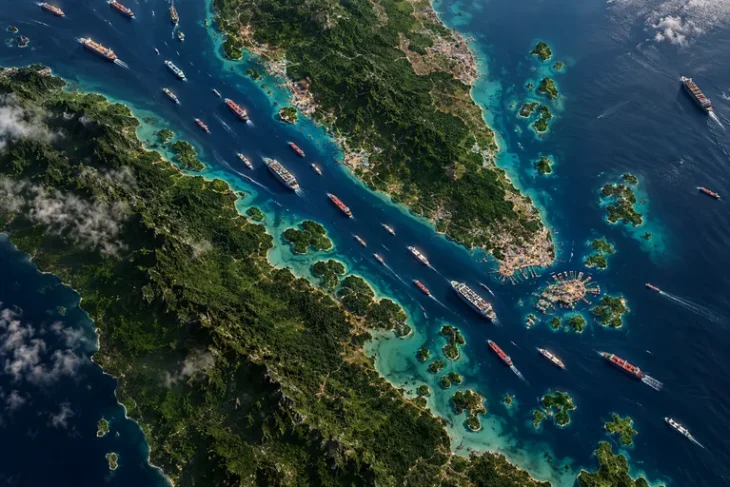
The Strait of Malacca lies between the Malay Peninsula and Indonesia’s Sumatra. Near Singapore, at the Phillips Channel, the usable passage narrows to roughly 1.7 miles — and the maximum ship class that fits is literally called “Malaccamax.” Through this funnel flows an enormous share of the commerce linking the Indian Ocean with East Asia.
Which forces an uncomfortable question in Beijing: what happens if we go to war and those ships stop coming?
Factories need energy. Trucks need diesel. Aircraft need fuel. Petrochemical plants need feedstocks. Modern civilization is basically an elaborate machine for converting energy into everything else. China built perhaps the greatest manufacturing machine in history — but the machine needs to eat.
The figures are stark: roughly 80% of China’s imported oil and about two-thirds of its trade pass through the Strait, while China accounts for nearly half of all oil transiting Malacca. In the first half of 2025, an estimated 23.2 million barrels of petroleum per day moved through Malacca — more than through Hormuz.
Enter India
Now look west — not toward America, but toward India.
India holds something fascinating: the Andaman and Nicobar Islands, stretching south through the Bay of Bengal, ending at remote Great Nicobar Island. For decades nobody paid it much attention. That’s changing. India is planning major infrastructure there — a container port, airport, power systems — sitting near the shipping lanes approaching Malacca. Suddenly that forgotten island looks a lot less forgotten, because geography has handed India something money can’t easily buy: position.
The String of Pearls
China understands the problem and has spent decades trying to solve it, building ports, infrastructure, and relationships across the Indian Ocean — Djibouti, Pakistan, Sri Lanka, Myanmar, Bangladesh. The collection is often called China’s “String of Pearls.” Look at a map and the logic is obvious: China wants places where its ships can operate, where energy can arrive, where dependence on foreign-dominated sea lanes shrinks. Above all, China wants alternatives — because great powers hate having only one road into town.
One of the biggest escape attempts is Pakistan. The idea was elegant: build the port of Gwadar on the Arabian Sea, unload oil and cargo there, move it north through Pakistan toward western China. A back door to the Indian Ocean — no Malacca. But between a port on the Arabian Sea and western China sit Pakistan, mountains, distance, cost, and politics. Infrastructure can overcome geography, but geography charges rent — sometimes enormous rent.
China tried Myanmar too: bring oil in from the Bay of Bengal and pipe it to Yunnan province. It works, to a point. But it can’t replace the vast volume of maritime commerce flowing through Southeast Asia — and Myanmar’s recent years of military rule and armed conflict mean China’s solution to one vulnerability created another. Welcome to geopolitics: there are very few solutions, mostly different collections of problems.
Someone always asks: why not just sail around Malacca? They can — via Indonesia’s Sunda and Lombok Straits. But longer routes mean more sailing, more fuel, more tankers, more money, fewer deliveries per ship per year. And in a major conflict, a longer detour doesn’t erase the strategic problem; it just moves it a few hundred miles down the ocean.
Then There’s Taiwan
This is where Malacca gets especially interesting. People picture a Taiwan war as a military contest — missiles versus defenses, aircraft versus aircraft, ships versus submarines. But wars aren’t only fought by soldiers. They’re fought by economies.
Imagine China launching a major operation against Taiwan. The first question is whether China can take Taiwan. But the second is whether China can keep feeding a gigantic industrial economy while doing it. China imports vast quantities of petroleum, natural gas, minerals, food, and industrial commodities — shipped through waters where Beijing lacks uncontested control. China wouldn’t just be attacking Taiwan; it would be betting that its entire global logistics system keeps functioning during the conflict. That’s a much bigger bet.
Don’t Get Carried Away
There’s another side to this. People talk about “closing Malacca” as if someone strolls over and shuts a gate. It isn’t that simple. Indonesia exists. Malaysia exists. Singapore exists. International shipping law exists. Japan needs the route. South Korea needs it. India needs it. Europe needs it. America’s containers are mixed in with everyone else’s. An Indian naval officer made the essential point: strangling Malacca would damage far more than China — and sustaining a blockade involving three sovereign neighbors would be far harder than announcing one. Never confuse having someone’s throat within reach with being able to squeeze it without breaking your own fingers.
So Why Does It Matter?
Because deterrence isn’t always about doing something. Sometimes it’s enough that the other fellow knows you could. India doesn’t need to close Malacca. America doesn’t need to close it. Nobody needs to close anything. The strategic value lies partly in Beijing having to think about the possibility — every tanker, every pipeline, every port, every naval base, every alternate route, every petroleum reserve, every ship China builds. Buried inside all those decisions is the same little geographical problem. Malacca.
The Great Irony
China has spent decades trying to reduce this vulnerability — ports, pipelines, railroads, the Belt and Road, naval expansion, overseas bases, strategic reserves, alternate routes. And yet geography stays stubborn. China sits on the Pacific; much of its energy sits across the Indian Ocean; between them lie narrow passages controlled or influenced by countries that aren’t China.
That doesn’t make China helpless — far from it. It’s building one of the world’s most powerful navies precisely because it grasps the problem. But it does mean China’s enormous industrial strength contains an equally enormous logistical dependency.
Every great power has an Achilles’ heel. America has debt. Russia has demographics. Europe has fragmentation. China has several — but the easiest to find requires nothing more than opening a map. Follow the oil tankers across the Persian Gulf, across the Indian Ocean, past India, toward Singapore. And eventually the ocean becomes very narrow.
Malacca. Malacca. Malacca.
China knows where its weakness is. The interesting question isn’t whether Beijing understands it. It’s what China is willing to do to make sure nobody ever gets the chance to use it.