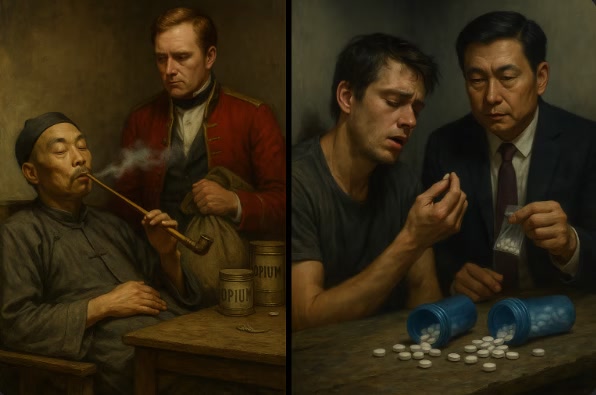
History has a nasty habit of circling back to bite folks where it hurts. In the 1800s, it was the British loading ships with opium to turn China into a nation of glassy-eyed addicts spending their silver on oblivion. Now it’s China shipping out powders so potent they could drop an elephant — and America is the one face-down on the table. The past isn’t dead; it’s alive and flying a different flag. There’s something almost poetic in the tragedy: the country hooked on foreign drugs two centuries ago may now be returning the favor. And as the body count climbs, we should remember addiction has always been a handy tool for anyone with something to sell — or a score to settle.
If there’s one lesson here, it’s that a nation’s weakness can be plain as day and easy for an old rival to exploit. Britain learned that when China’s hunger for silver became an opium nightmare. Now it’s America’s turn, strung out on a high so cheap it kills by the thousands. But raging about foreign devils won’t cure the homegrown hunger driving people toward that lethal comfort — and as long as poison turns a profit, somebody will keep it flowing.
Britain’s 19th-Century Opium Play Against China
In the early 1800s, the British Empire deliberately used opium as a weapon to bring China to its knees. British traders, with London’s blessing, flooded Qing China with opium grown in British India, sparking mass addiction and social breakdown. When Chinese officials seized and destroyed millions of pounds of illegal opium in 1839, Britain answered with warships. The First Opium War ended in swift Chinese defeat; the treaties pried open China’s ports to foreign commerce and handed over Hong Kong. A second war twenty years later deepened the humiliation, launching China’s “Century of Humiliation” — foreign powers got rich while a drug-sickened China lost sovereignty. Opium wrecked millions of lives, proving narcotics could serve as an instrument of empire.
China’s Role in Today’s Fentanyl Epidemic
Fast-forward to America’s fentanyl crisis, and the tables look ironically turned. China — once the victim of Britain’s opium scheme — has become the chief source of the chemicals behind the U.S. epidemic. Over the last decade, Chinese labs and trading firms became the main suppliers of fentanyl itself, and more recently of the precursor chemicals used to cook it. From roughly 2013 to 2018, large volumes of finished fentanyl flowed straight from China to American buyers, often by international mail, fueling a surge in fatal overdoses. In 2019, under American pressure, Beijing banned the entire fentanyl family — the first country to do so — sharply cutting direct shipments.
But Chinese suppliers adapted fast. Instead of shipping finished product, they began exporting the raw ingredients in bulk, frequently mislabeled and routed to Mexico. There, the Sinaloa and Jalisco cartels synthesize them into fentanyl pills and powder, then smuggle them across the U.S. border. In effect, Mexico became the visible face of the trade while Chinese chemicals stayed at its core.
Criminal networks on both sides of the Pacific keep this lethal pipeline running. Investigations show how easily fentanyl precursors can be bought online from Chinese vendors and shipped amid mountains of legitimate cargo. Many of the firms involved pose as ordinary chemical companies exploiting China’s vast chemical sector, operating in legal gray zones and selling substances not yet banned. Freelance middlemen broker deals with Mexican traffickers and even supply synthesis instructions, while Chinese money-laundering networks clean cartel profits hand-in-glove with the gangs. Put simply, China is the linchpin of the modern fentanyl supply chain — playing the producer-and-financier role that 19th-century Britain once played in the opium trade.
Is Beijing Looking the Other Way?
The parallel raises an uncomfortable question: is Beijing willfully ignoring — or quietly enabling — the synthetic opioid flood devastating America? Recent investigations (2023–2025) suggest elements of the Chinese state may be tolerating or assisting this deadly commerce. A bipartisan House committee report in April 2024 accused Beijing of directly subsidizing the fentanyl supply chain, uncovering government records showing tax rebates for manufacturers of specific fentanyl precursors — as long as the chemicals were exported. The same report charged that the Party lets known drug networks operate freely “as long as their efforts are focused abroad,” tolerating crime that feeds America’s epidemic while keeping China untouched.
More disturbing still, the committee found Chinese officials had sabotaged narcotics investigations — tipping off suspects inside China when U.S. law enforcement sought help, giving them time to destroy evidence. Former Attorney General William Barr told Congress it’s “hard to believe” a country with China’s surveillance apparatus is “not fully aware” of large-scale fentanyl production, citing “persuasive evidence” Beijing was “knee deep in sponsoring and facilitating the export of fentanyl precursors.” Some analysts now openly call it a “reverse Opium War” — the deliberate destabilization of American society through drugs.
Beijing’s motives are debated. One theory is plain economics: the opioid pipeline is wildly profitable, and Chinese chemical makers earn billions from precursor sales. Another is strategic: hardliners steeped in nationalist narratives of past exploitation may quietly view America’s suffering as vengeance. Direct proof of a centrally ordered plot is missing — U.S. intelligence has found no official “drug warfare” policy. But the net result is undeniable: China profits while its chief rival buries over 100,000 overdose victims a year. A government that executes domestic drug dealers yet can’t stop the outflow? That smells like a lack of political will, not capability.
The Regulatory Loopholes That Keep It Flowing
China’s chemical controls are riddled with gaps. Despite boasting some of the toughest drug laws on paper — a legacy of the Opium Wars — traffickers exploit weak enforcement. Most fentanyl precursors remain unscheduled under Chinese law; chemists keep inventing analogs outside each ban. These dual-use chemicals face minimal oversight, and Beijing claims that if a substance isn’t scheduled, it “cannot prosecute” the makers. Washington has pushed for conspiracy charges and “know-your-customer” rules; Beijing has refused. So Chinese firms plead ignorance, insisting they sell ordinary industrial chemicals.
Critics call this a loophole by design. China could pass licensing and vetting laws — but hasn’t. Enforcement has been feeble: a handful of indictments, usually under U.S. pressure. “We have not seen robust prosecution in China,” observed Brookings expert Vanda Felbab-Brown. The kingpins operate with near impunity, as long as they spare China’s own population — a stark contrast with how Germany or Japan would respond to the same diversion.
When Cooperation Became a Bargaining Chip
Fentanyl has become tangled in the broader U.S.–China rivalry. In August 2022, after Nancy Pelosi’s Taiwan visit, Beijing suspended all drug-enforcement collaboration — even as American overdoses soared — openly tying the cutoff to U.S. “hostility.” Beijing habitually links law-enforcement cooperation to the political weather: bad relations, no help. Talks stayed frozen until Washington lifted sanctions on a Chinese police forensics institute, after which Xi and Biden announced renewed cooperation in November 2023.
Some progress followed — more precursors scheduled, agency talks resumed. But trust is paper-thin. U.S. officials accuse Beijing of “slow-walking” action against big suppliers and money launderers, while Washington’s indictments and sanctions draw Chinese warnings that pressure will “undermine the foundation” of joint efforts. Every diplomatic dip now threatens the fragile cooperation.
Beijing’s Denials Versus the Evidence
Beijing furiously rejects the accusation. “China was a painful victim of opium in history,” then-Ambassador Qin Gang said in 2022, claiming that legacy makes China empathize with America’s plight. Chinese diplomats call the payback theory “false and misleading,” cite the 2019 ban as proof of good faith, and insist China has “done everything possible.” “The root cause of the drug epidemic in the U.S. lies in the U.S. itself,” spokeswoman Mao Ning declared.
Yet investigators keep punching holes in the story. The precursor tax rebates are documented on Chinese government websites. No Chinese kingpins have faced serious punishment — a striking contrast with China’s death-penalty treatment of domestic drug crime. Reuters stings found Chinese firms openly marketing fentanyl ingredients online and offering to mislabel shipments. Given China’s vast surveillance powers, this open black market suggests unspoken tolerance. As Brookings put it, the “lack of will” in Beijing is the core problem.
Breaking the Cycle
The British opium campaign and China’s fentanyl connection are 180 years apart — yet the parallels are jarring. In both cases, a great power’s hunger for profit unleashed a drug epidemic on a rival. History doesn’t repeat exactly, but it sure does rhyme. There are glimmers of hope: diplomacy has worked before — the 2019 ban, the recent precursor additions. A sustained, verifiable crackdown on China’s illicit chemical exporters, paired with demand-reduction and treatment in America, could turn the tide.
For China, which celebrates its victory over opium, profiting from a new narcotic scourge stains its reputation. For America, beating fentanyl is a domestic priority and a geopolitical imperative. Weaponized drugs can fell nations — learning from that past, instead of letting cynical economics or revenge keep the suffering alive, is the only way this chapter ends with lives saved rather than another nation laid low.