China’s economic miracle didn’t begin when communism finally worked. It began when China stopped insisting on it.
For decades, China tried to manufacture prosperity through orthodox communist economics: collectivized farms, state ownership, central planning, fixed prices, production quotas, and ideological control over economic life. The result wasn’t prosperity. It was poverty on a historic scale.
When the Communists seized power in 1949, China was already destitute after civil war and Japanese occupation. Mao Zedong then set out to remake the economy according to revolutionary ideology. The most catastrophic experiment was the Great Leap Forward. Beginning in 1958, Mao tried to industrialize at breakneck speed while herding agriculture into giant communes. Farmers were dragged from fields, farm tools were melted in crude backyard furnaces to boost steel output, and planners imposed fantasy production targets. The famine that followed killed tens of millions — estimates range from roughly 15 million to over 50 million dead.
Then came the Cultural Revolution. Schools shuttered. Intellectuals persecuted. Historic treasures smashed. Expertise itself became suspect because ideology outranked knowledge. By Mao’s death in 1976, China had nearly a billion people and a per-capita GDP of about $175.
And then something remarkable happened. China didn’t announce: “Communism failed. We’re capitalists now.” Political systems rarely confess failure that bluntly. Instead, China began quietly rewriting the rules.
Enter Deng Xiaoping
Deng Xiaoping was a communist revolutionary — but also a pragmatist. He’d already landed in trouble under Mao for suggesting limited private ownership might be acceptable if it boosted output. Mao treated that as dangerous capitalist backsliding.
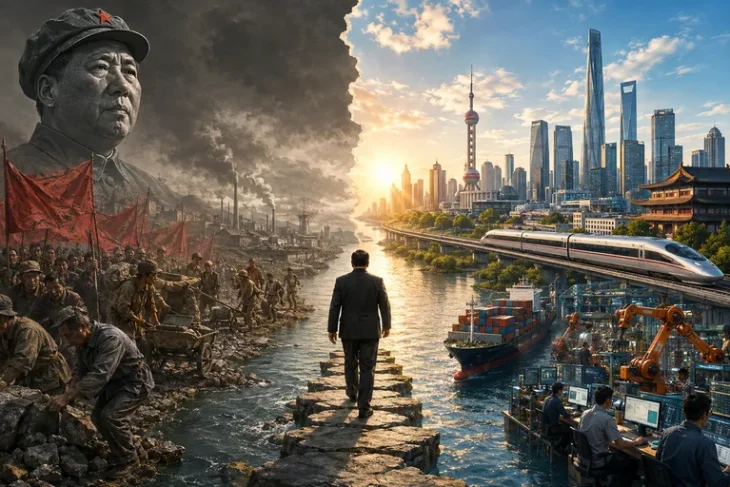
After Mao’s death, Deng rose to dominance with one guiding principle: results mattered more than ideological purity. Chinese reformers called their method “crossing the river by feeling for the stones.” Don’t design the whole economy from political theory. Try something. See if it works. Keep what works. Discard what doesn’t. Take another step. That may be the most important economic lesson of the twentieth century.
Deng launched “Reform and Opening Up.” China rebuilt ties with countries it had once denounced as ideological enemies and began studying how successful economies actually functioned. And here’s the part that deserves more attention: the Chinese started asking capitalists how capitalism worked.
Chinese officials traveled abroad. Deng toured Japanese factories and visited America, walking through Ford and Boeing plants to understand modern manufacturing. China invited foreign economists in — including Milton Friedman, the Nobel laureate and champion of free markets, to lecture Chinese officials. Students and economists were dispatched to Western universities to study mathematical economics, econometrics, finance, and modern management.
Think about that. One of the world’s largest communist countries was effectively admitting: we need to learn why capitalist economies produce things we cannot. That was a colossal intellectual shift.
Political Control Stayed; Economic Control Loosened
This distinction is critical. Deng was no Western liberal. He was determined to preserve the Communist Party’s political monopoly — dissent stayed heavily restricted. What Deng separated was political power from economic organization. China could remain authoritarian politically while behaving increasingly capitalist economically.
Call it socialism, a socialist market economy, state capitalism — the label matters less than what changed. Private incentives appeared. Enterprises gained autonomy and could keep portions of their profits. Foreign investment was welcomed. Special Economic Zones were established. Market pricing gradually replaced administrative pricing. Entrepreneurship was increasingly tolerated. And people responded exactly as incentives predict: they started producing.
The Cleverest Trick: Don’t Smash the Old System Overnight
China faced a lethal problem. You can’t shut down a giant centrally planned economy on Monday and declare free-market capitalism on Tuesday. Millions depend on the existing system — factory quotas, jobs, controlled prices, government supply chains. Smash everything at once and the whole edifice collapses.
So China tried something ingenious: the dual-track system. A factory might still owe the state 10,000 units at the official price. But if it could make 15,000, the extra 5,000 could be sold on the market at whatever buyers would pay. The communist economy remained — but a market economy began growing around it. Picture the planned economy as a small bonsai tree: instead of cutting it down, China planted a forest around it. Eventually the forest dwarfed the tree. That’s essentially what happened.
It wasn’t a flawless master plan. Experiments failed. Price reforms fed inflation. Corruption exploded where officials bought at state prices and resold at market prices. A rushed 1988 liberalization triggered panic buying and bank runs. China adjusted again. Deng’s system wasn’t “we possess the perfect theory” — it was “try it, measure it, fix it.” Almost the opposite of Mao-era ideological rigidity.
Tiananmen Drew the Line
Economic freedom created a new problem: people tasting economic liberty began demanding political liberty. Those tensions fed the massive 1989 demonstrations in Tiananmen Square. Deng sided with the hardliners; the military cleared the square, and hundreds — possibly thousands — died. The boundary was now brutally clear: markets could be liberalized, but the Party could not be challenged. Economic liberalization without political liberalization.
Reform stalled for a few years. Then Deng, at 88, toured southern China in 1992 — including booming Shenzhen — signaling reform would continue. A year later, China formally rewrote its constitutional language: no longer a “planned economy based on socialist public ownership,” but a “socialist market economy.” The transformation was official.
The Results Were Staggering
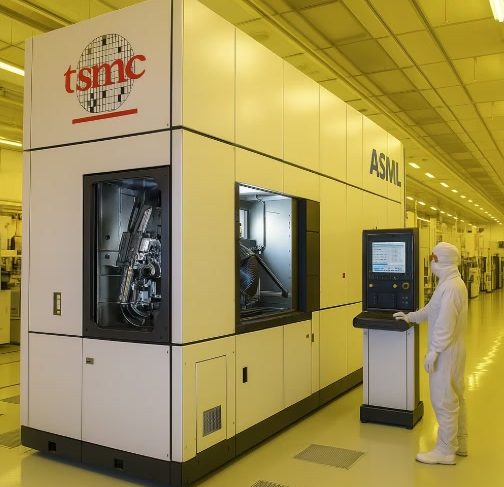
Whatever you call it, China’s economic transformation became one of history’s great events. Over roughly four decades, close to 800 million people were lifted from extreme poverty. China went from one of Earth’s poorest major nations to an industrial titan — factories rising, cities exploding, exports surging, infrastructure spreading. Foreign capital and technology poured in. Hundreds of millions moved from subsistence farming into industry and commerce. China became the world’s second-largest economy.
The Irony at the Heart of It
Here’s where the story gets truly interesting. China abandoned much of communist economics without abandoning Communist Party control. That distinction explains modern China. The government still calls the system socialism. The Party still rules. The state still owns or steers huge swaths of the economy. But the engine that transformed China increasingly ran on things classical communism was supposed to abolish: markets, profit, competition, private enterprise, foreign investment, individual incentives, international trade.
China discovered you can command people politically far more easily than you can command an economy — because an economy is billions of simultaneous decisions. What should it cost? How many should we make? Where should it ship? Should we build another factory? No planning ministry can hold all that information. Markets distribute those decisions among millions of people. When China let people make more of those decisions themselves, the economy exploded.
Deng’s genius wasn’t inventing capitalism — it already existed. His genius was recognizing China’s system wasn’t working and being willing to steal good ideas from anyone who had them: capitalists, socialists, Americans, Japanese, Europeans, economists, engineers, factory managers. He cared less about where an idea came from than whether it produced results.
Ideology tells you what should work. Reality tells you what actually works. Mao tried to force reality to fit ideology. Deng forced ideology to accommodate reality. And China changed.
The irony is enormous. One of history’s greatest economic transformations happened not because China perfected communism — but because, after decades of catastrophe and poverty, it progressively allowed the very market mechanisms communism had been created to replace. China never stopped calling itself communist. It simply stopped running much of its economy as though communism actually worked.