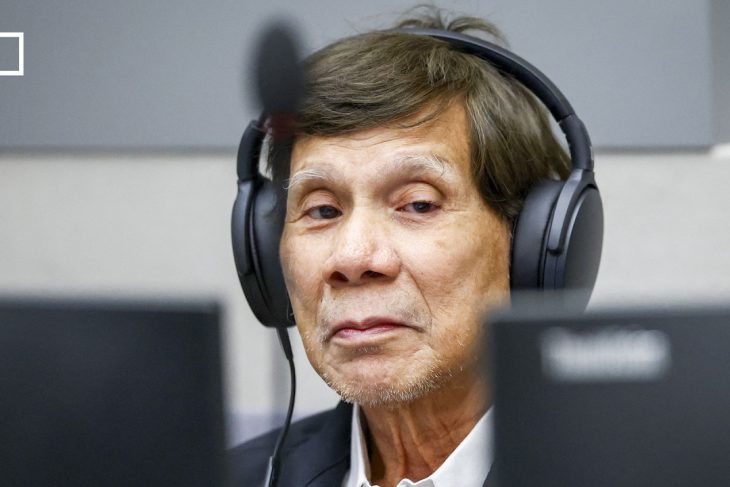
Hong Kong activist Joshua Wong Chi-fung was sentenced on Thursday to 10 years in prison for conspiring to collude with foreign forces, in a second national security conviction that extends his time behind bars by a decade. Wong, who turned 30 last month, had pleaded guilty in September to conspiring with fellow activists to invite foreign sanctions against mainland China and Hong Kong in the aftermath of the 2019 anti-government protests. High Court Judge William Tam called the case “grave” and said the punishment had to fit the gravity of the crime. The sentence was shorter than the maximum penalty of life imprisonment, but far longer than the four and a half years Wong’s lawyers had asked for. It means the best-known face of Hong Kong’s pro-democracy generation will be 40 years old before he leaves prison.
The mechanics of the sentence underline how close Wong had come to freedom. He was already serving four years and eight months for conspiracy to commit subversion, a sentence imposed in the city’s landmark unofficial-primaries case, and that term was due to finish on January 7 next year, with only about two months left to run. The court ordered that remaining time — two months and two days — to run concurrently with the new 10-year term. Even with that small overlap, the effect is to push his expected release back to November 2036. Judge Tam said he had taken 13 years as the starting point for the sentence and reduced it because Wong pleaded guilty, while rejecting the argument that the activist’s role in the conspiracy had been limited.
From Teenage Protest Leader to Prisoner
Wong’s rise began when he was barely into his teens. At 14 he helped found the student group Scholarism, which in 2012 forced the Hong Kong government to shelve plans for patriotic national education in schools, an early and startling victory over Beijing-backed policy. In 2014 he became one of the most recognisable leaders of the Umbrella Movement, when tens of thousands of protesters occupied Hong Kong’s streets for 79 days demanding genuine universal suffrage. He later co-founded the political party Demosisto and travelled the world lobbying foreign governments to support Hong Kong’s democracy movement. That international advocacy — speeches, meetings and testimony abroad — built his global profile, and it is the same activity that prosecutors later placed at the centre of their case against him.
The turning point came in 2019, when mass protests against a proposed extradition bill convulsed the city for months and at times turned violent. Beijing responded in June 2020 by imposing a sweeping National Security Law on Hong Kong, criminalising secession, subversion, terrorism and collusion with foreign forces. The law transformed the legal landscape overnight, and much of the advocacy that Wong and his peers had practised openly for a decade fell within its reach. Wong has been in detention continuously since late 2020, through a succession of cases arising from the protest era. Thursday’s sentence is the heaviest single punishment he has received.
Two National Security Cases, Six Years Apart in Court
The subversion sentence Wong is finishing came from Hong Kong’s largest national security prosecution. He was one of 47 opposition figures charged over an unofficial primary election held in 2020 to choose candidates for the Legislative Council, and one of 45 ultimately jailed in 2024 after the trial concluded. His four years and eight months in that case made him one of the more lightly sentenced defendants, in part because of his early guilty plea. Before the collusion charge was brought in 2025, he was on course to walk free in January and resume life outside prison for the first time in more than six years. The new prosecution, filed while he was still serving the first sentence, reset that clock entirely.
The collusion case concerned events between July 1 and November 23, 2020 — the first months after the security law took effect. Prosecutors accused Wong of conspiring with self-exiled activist Nathan Law and others to ask foreign countries and organisations to impose sanctions, blockades or other hostile measures against Hong Kong and China. The judge pointed to real-world measures of that period, including the United States revoking Hong Kong’s preferential special status and sanctioning Chinese and Hong Kong officials, as the kind of actions the conspiracy had sought. The court said the conviction rested on Wong’s conduct after the law was enacted, though his earlier activities informed the assessment of gravity. Wong, for his part, said he had mistakenly believed his actions were within the law, and that he had never advocated Hong Kong independence or the collapse of China.
Reactions at Home and Abroad
Hong Kong’s leadership defended the sentence in the strongest terms. Chief Executive John Lee, himself a former security chief, said after the hearing that Wong and Law had committed “extremely serious offences” that undermined national sovereignty, security and development interests and prejudiced the well-being of the public. Beijing, through its officials, warned foreign governments against making what it called irresponsible remarks about the trial. Supporters of the law argue that lobbying foreign states to sanction one’s own city crosses a line that many countries police in their own statutes. To the authorities, the length of the sentence reflects both the seriousness of that offence and a deterrent message to anyone considering similar campaigns.
Abroad, the reaction was sharply critical. The United States consulate in Hong Kong said it strongly condemned the 10-year sentence, and American officials described Wong as unjustly imprisoned for advocating fundamental freedoms. Amnesty International said the case showed the National Security Law being used as a tool to punish dissent, noting that the conduct punished was a campaign of international advocacy rather than violence. Human rights groups argue that the law’s broad wording has swept up peaceful political activity that was legal and commonplace in Hong Kong before 2020. The divide in reactions mirrors the divide over the law itself, which supporters call a restoration of stability and critics call the end of the city’s promised autonomy.
For Hong Kong’s pro-democracy movement, the sentence closes another door. Its best-known figures are now in prison, in exile like Nathan Law, or silent under the pressure of the security law, and the parties and newsrooms that once sustained the movement have been dissolved or closed. Wong entered prison at 23 as a former student leader with a political future in front of him; on Thursday’s sentence he will leave it, if the term runs in full, at 40. Whatever view is taken of his case, its symbolism is hard to miss. The teenager who once filled Hong Kong’s streets with supporters will spend the whole of his thirties in a cell, under a law written for the protests he helped to lead.
Source: South China Morning Post