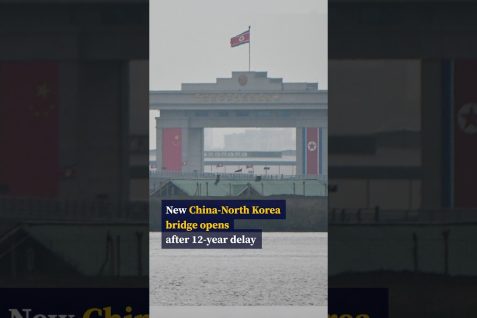
A bridge between China and North Korea that was completed 12 years ago finally opened on Thursday. The two countries held an opening ceremony to mark the official opening of the New Yalu River Bridge. The bridge links the Chinese city of Dandong with North Korea’s Sinuiju and is expected to become a major trade route between the two countries.
A bridge between China and North Korea that was completed 12 years ago finally opened on Thursday. The two countries held an opening ceremony to mark the official opening of the New Yalu River Bridge. The bridge links the Chinese city of Dandong with North Korea’s Sinuiju and is expected to become a major trade route between the two countries.
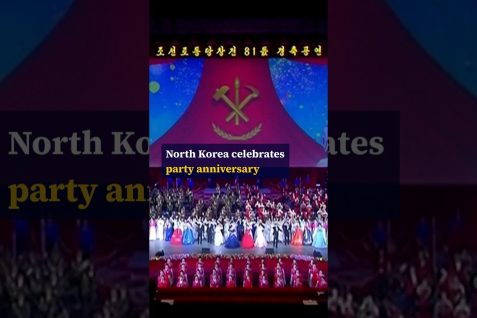
North Korean leader Kim Jong-un attended a celebratory performance on Saturday with his daughter Kim Ju-ae to mark the 81st anniversary of the ruling Workers’ Party of Korea. Ju-ae has made increasingly frequent public appearances in North Korea’s state media, with Seoul claiming that she has effectively become the successor-in-waiting of the Kim dynasty.
North Korean leader Kim Jong-un attended a celebratory performance on Saturday with his daughter Kim Ju-ae to mark the 81st anniversary of the ruling Workers’ Party of Korea. Ju-ae has made increasingly frequent public appearances in North Korea’s state media, with Seoul claiming that she has effectively become the successor-in-waiting of the Kim dynasty.
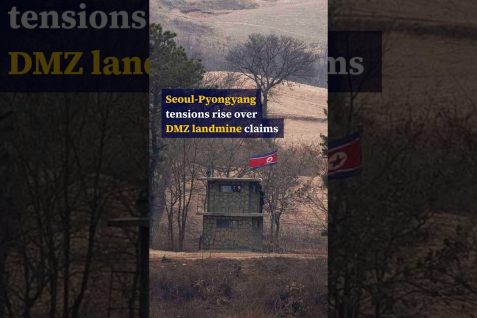
South Korea’s military has released a video it described as showing a mine exploding Monday during an operation to clear mines along its tense border with the North. Seoul has been working to remove explosives after three of its soldiers were hurt in a September 21 blast it blamed on a North Korean mine in the inter-Korean demilitarised zone (DMZ). South Korea says the North has been placing mines in areas that violate a truce between the nations. Pyongyang has dismissed the accusations and rejected Seoul’s call for an apology.
South Korea’s military has released a video it described as showing a mine exploding Monday during an operation to clear mines along its tense border with the North. Seoul has been working to remove explosives after three of its soldiers were hurt in a September 21 blast it blamed on a North Korean mine in the inter-Korean demilitarised zone (DMZ). South Korea says the North has been placing mines in areas that violate a truce between the nations. Pyongyang has dismissed the accusations and rejected Seoul’s call for an apology.
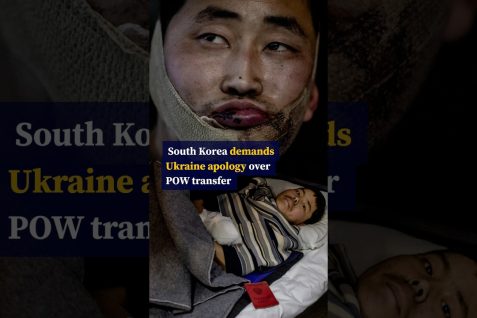
South Korea’s presidential office has demanded an official explanation and apology from Ukraine, after Ukrainian President Volodymyr Zelensky told the UN General Assembly last week that Kyiv had transferred two North Korean prisoners of war (POWs) to South Korea. Seoul says the disclosure was made without sufficient prior consultation and that Kyiv had falsely denied both sides had agreed to keep the move confidential.
South Korea’s presidential office has demanded an official explanation and apology from Ukraine, after Ukrainian President Volodymyr Zelensky told the UN General Assembly last week that Kyiv had transferred two North Korean prisoners of war (POWs) to South Korea. Seoul says the disclosure was made without sufficient prior consultation and that Kyiv had falsely denied both sides had agreed to keep the move confidential.
Japan is debating one of the biggest shifts in its postwar defense policy: whether to acquire nuclear-powered submarines. The discussion comes as Tokyo accel
Japan is debating one of the biggest shifts in its postwar defense policy: whether to acquire nuclear-powered submarines. The discussion comes as Tokyo accelerates its military buildup in response to growing pressure from China, Russia and North Korea, while expanding joint exercises with the United States and Australia. At the same time, Okinawa has elected a new governor who supports relocating the US Marine Corps' Futenma Air Station to Henoko, potentially giving Japan's government greater freedom to strengthen its southwestern defenses near Taiwan. As Chinese and Russian military activity intensifies around Japan and North Korea expands its naval capabilities, is Tokyo entering a new era of deterrence? In this episode, we examine Japan's submarine debate, the strategic significance of Okinawa, and what these developments could mean for Taiwan, the First Island Chain and security across the Indo-Pacific.
A bipartisan bill aims to expand sanctions on Russia and Iran. China, a major buyer of Russian oil, could also be targeted.Concerns about artificial intellig
A bipartisan bill aims to expand sanctions on Russia and Iran. China, a major buyer of Russian oil, could also be targeted. Concerns about artificial intelligence are emerging in both the West and the East. Epoch Times reporter Nathan Su says a change in mindset is needed. “China has been conducting unrestricted warfare against the United States since the mid-'90s. They are at war with us, but we think they are our competitor. You can’t win a war when you go into it with the mentality of competition,” he said. A former U.S. soldier pleads guilty to collecting sensitive information about U.S. weapons for Beijing. And a proposed sale of advanced U.S. fighter jets to Saudi Arabia is raising concerns among American officials over the kingdom’s ties to China. We’ll look at the deal and what’s at stake. 00:00 Intro 01:11 China Targeted Over U.S. Sanctions on Russia, Iran 02:33 House Bill Requires Data Centers to Pay for Electricity Spikes 03:34 OpenAI Found More Instances of Deceptive Models 04:11 China’s Spy Chief Warns AI Is a Threat to Party Rule 06:34 What’s Behind Beijing’s AI Warning? 08:44 U.S. Must Recognize China Is at War With Us 10:17 Huawei Staff Allegedly Took Photos of T-Mobile Robot 11:48 Former U.S. Soldier Pleads Guilty in China Spy Case 12:20 F-35 Sale Raises Concerns Over Saudi-China Ties 13:44 House Hearing Probes CCP, North Korean Repression 16:47 Jimmy Lai’s Son Appeals to Xi for Father’s Freedom 19:38 Carney: Canada Will Decide Its Own Partnerships 20:48 Trump Threatens EU With Tariffs Over Canada Association 21:42 Taiwan Plans Rare Philippines Visit Amid China Tensions
North Korean leader Kim Jong-un has commissioned the country’s second naval destroyer, state media reported on Monday. The vessel equipped with nuclear-capable missiles was launched Sunday, the day before the US, South Korea and Japan started their latest trilateral military exercise, which Pyongyang sees as a security threat. North Korea has continued to dial up pressure on Washington after rebuffing US President Donald Trump’s conciliatory move to scale back US participation in a major military drill with South Korea last month.
North Korean leader Kim Jong-un has commissioned the country’s second naval destroyer, state media reported on Monday. The vessel equipped with nuclear-capable missiles was launched Sunday, the day before the US, South Korea and Japan started their latest trilateral military exercise, which Pyongyang sees as a security threat. North Korea has continued to dial up pressure on Washington after rebuffing US President Donald Trump’s conciliatory move to scale back US participation in a major military drill with South Korea last month.
While taking questions from reporters on Monday, President Donald Trump spoke about attempts to connect with North Korean Supreme Leader Kim Jong Un. Source: 'Did You Speak To Him?': Trump Pressed …
When you think of naval powers, North Korea probably isn’t at the top of your list…and frankly given the state of their naval forces for the last seventy years it shouldn’t …
When you think of naval powers, North Korea probably isn’t at the top of your list…and frankly given the state of their naval forces for the last seventy years it shouldn’t be. But now the DPRK apparently has ambitions to nuclear-armed, Blue Water navy status, and it’s pouring funding into subs and surface combatants to try and get there. So today, let’s talk about North Korea’s weird new navy.
The video examines recent developments in North Korea's naval capabilities, noting a shift from historical limitations to new ambitions for a blue water navy. The content highlights reports of the commissioning and testing of guided missile destroyers such as the Choe Hyon and Kang Kon, alongside claims that cruise missiles capable of carrying tactical nuclear weapons have been deployed. It mentions statements by Kim Jong Un regarding plans to construct two warships annually over the next five years and aspirations for vessels weighing up to 10,000 tonnes. The overview also touches on alleged Russian financial support linked to military aid provided during conflicts in Ukraine. Additionally, there are references to a nuclear-powered submarine development program and potential technology sharing with Russia. The discussion frames these actions within a broader strategic perspective while emphasizing that the material is presented for entertainment purposes rather than as definitive legal or comprehensive analysis of international events.
Is Washington’s attention shifting away from the Indo-Pacific? Japan’s prime minister says not at all, following talks with President Donald Trump at the G7 summit. After Iran, could North Korea be …
Is Washington’s attention shifting away from the Indo-Pacific? Japan’s prime minister says not at all, following talks with President Donald Trump at the G7 summit. After Iran, could North Korea be next? South Korea is urging Trump to help address one of the world’s toughest nuclear challenges. The G7 leaders say they oppose any actions that could disrupt peace around Taiwan, and Trump is pushing to speed up U.S. weapons manufacturing. The Senate unanimously passed a bill condemning Chinese Communist Party leader Xi Jinping. Missouri’s attorney general is suing Chinese security camera maker Lorex, a major seller of home security cameras and baby monitors in the United States. What’s the case really about? 00:00 Intro 1:24 Japan, U.S. Reaffirm Indo-Pacific Partnership at G7 3:20 S. Korea Asks Trump to Tackle N. Korea Nuclear Threat 4:28 S. Korea Narrows Civilian Restricted Zone Near Border 4:52 G7 Leaders Support Taiwan Strait Status Quo 5:25 Taiwan Detects 6 Chinese Naval Vessels Near Island 6:12 President Trump Invokes Act to Boost Weapons Supply 7:04 Senate Resolution Condemns CCP Leader Xi Jinping 9:13 Missouri AG Sues Baby Monitor Firm Over CCP Ties 11:03 Taiwan Protests Scholar Ban, Cites CCP Pressure 12:27 Taiwan on Standby for Possible Call From Trump 13:12 EU Says China Trained Russian Troops to Fight in Ukraine 14:40 G7 Summit Highlights China Concerns in France 15:04 G7 Unites on China Security, Economic Concerns 16:09 G7 Seeks Supply Chain Shift Away From China 17:26 G7 Pushes to Cut Reliance on Chinese Minerals 19:06 G7 Signals Security-First Approach on China Talks
This NTD report titled China in Focus examines recent developments involving the United States, Japan, and other G7 nations regarding their strategic partnership in the Indo-Pacific region. Following talks between President Donald Trump and Japanese Prime Minister Shigeru Ishiba at the G7 summit in France, both leaders reaffirmed their commitment to the alliance. The summit also addressed pressing security issues, including North Korea's nuclear program, with South Korea urging Washington to assist in resolving this challenge. Additionally, G7 leaders expressed opposition to actions that could destabilize peace around Taiwan, while President Trump advocated for accelerating U.S. weapons manufacturing.
The report highlights legislative and legal actions against China, noting the Senate's unanimous passage of a bill condemning Chinese Communist Party leader Xi Jinping. It also covers a lawsuit filed by Missouri's attorney general against Lorex, a manufacturer of home security cameras and baby monitors accused of ties to the CCP. Other segments discuss Taiwan detecting Chinese naval vessels near the island, EU allegations that China trained Russian troops for the Ukraine conflict, and G7 efforts to reduce reliance on Chinese minerals and shift supply chains away from Beijing. The coverage concludes with various diplomatic signals and protests related to these escalating tensions.
Xi Jinping’s first overseas trip in seven months was supposed to showcase China’s influence over North Korea. But did it? In this program, we examine the unusual details of Xi’s visit …
Xi Jinping’s first overseas trip in seven months was supposed to showcase China’s influence over North Korea. But did it? In this program, we examine the unusual details of Xi’s visit to Pyongyang, from the surprising “good health” chants and scaled-back welcome ceremony to Kim Yo-jong’s public rejection of denuclearization just before Xi arrived. We also explore Kim Jong-un’s strategic balancing act between China, Russia, and the United States, why North Korea is moving away from traditional communism, and why some analysts believe Kim—not Xi—walked away as the bigger winner. Finally, we’ll look at two remarkable historical precedents involving Hua Guofeng and Zhao Ziyang that may shed light on the risks Xi faces when he returns to Beijing.
This video from Lei's Real Talk examines the details of President Xi Jinping's recent visit to North Korea, which was intended to demonstrate Chinese influence over Pyongyang. The program highlights several unusual aspects of the trip, including scaled-back welcome ceremonies and public chants regarding Kim Jong-un's health that surprised observers. It also notes Kim Yo-jong's public rejection of denuclearization shortly before Xi's arrival, suggesting a complex diplomatic dynamic. The analysis explores how North Korea is balancing its relationships with China, Russia, and the United States while moving away from traditional communist structures. Furthermore, the discussion considers why some analysts believe Kim Jong-un emerged as the primary beneficiary of the visit rather than President Xi. The overview concludes by referencing two historical precedents involving Hua Guofeng and Zhao Ziyang to illustrate potential risks facing Chinese leadership upon returning home. Additional links in the description promote related content on soft coups, prophetic predictions for 2026, and various support channels for the creator.
The CCP’s most extreme June 4 censorship campaign in years. A missing Politburo meeting. A 10-day disappearance by Xi Jinping. And now, a sudden trip to North Korea. Beijing says nothing, …
The CCP’s most extreme June 4 censorship campaign in years. A missing Politburo meeting. A 10-day disappearance by Xi Jinping. And now, a sudden trip to North Korea. Beijing says nothing, but the silence itself may be the biggest story. Since the CCP’s 20th Party Congress, every previous missing Politburo report was followed by a major political development. Tonight, we examine the mystery unfolding inside Zhongnanhai, the strange timing of Xi’s reappearance, the historical warning from Zhao Ziyang’s 1989 Pyongyang trip, and why the regime appears more nervous than ever on the 37th anniversary of Tiananmen. Sometimes what Beijing doesn’t say is more revealing than what it does.
This video from Lei's Real Talk examines a series of unusual events surrounding the Chinese leadership during late June. The content highlights what is described as an extreme censorship campaign marking the 37th anniversary of Tiananmen Square. It notes that President Xi Jinping disappeared for ten days before making a sudden trip to North Korea, while Beijing issued no official explanation. The analysis suggests that this silence itself may be significant, drawing parallels to historical precedents where missing Politburo meetings were followed by major political developments since the 20th Party Congress. The discussion also references a specific historical warning linked to Zhao Ziyang's 1989 Pyongyang trip. Additionally, the video touches upon the CCP's June 4 censorship efforts, which are characterized as one of the most severe in recent years. The overall narrative focuses on interpreting these gaps in official communication and the timing of leadership movements within Zhongnanhai. Viewers are invited to consider why the regime might appear more cautious during this period. The presentation includes links to related music videos and other content from the creator's various channels, along with information on how to support the work financially or through an online shop.
China Update provides the most up to date political, economic, and geopolitical news and analysis on China. Videos are based on hundreds of articles, think tank reports, government statements and other …
China Update provides the most up to date political, economic, and geopolitical news and analysis on China. Videos are based on hundreds of articles, think tank reports, government statements and other resources in English and Chinese. China Update is fully independent and I make the videos. X (Formerly Twitter): / tonychinaupdate Channel email: [email protected] 00:00 Introduction 00:11 Xi Arrives in North Korea 02:44 Heavy Rain & Flooding Threatens Southern China 05:56 EU-China: The German Debate 08:53 China Carbon Emissions
This video from the independent channel China Update offers a concise geopolitical and economic overview of recent developments involving China. The segment begins with President Xi Jinping's visit to North Korea, highlighting diplomatic movements in the region. Attention then shifts to severe weather conditions affecting southern China, where heavy rain and flooding pose significant threats to local infrastructure and populations. The discussion also covers ongoing debates within Germany regarding its relationship with China, reflecting broader European concerns about economic ties and strategic alignment. Additionally, the video addresses environmental issues, specifically focusing on China's carbon emissions and related policy discussions. Throughout the presentation, the channel emphasizes its commitment to providing up-to-date analysis based on a wide range of sources, including government statements and think tank reports. Viewers are reminded that the content is for informational purposes only and does not constitute financial or investment advice. The production maintains a neutral tone while exploring complex international dynamics without making definitive claims beyond available public information.
President Donald Trump’s eldest son says he wouldn’t consider investing in China and is warning others about the risks. An American journalist pleads guilty to acting as a foreign agent of …
President Donald Trump’s eldest son says he wouldn’t consider investing in China and is warning others about the risks. An American journalist pleads guilty to acting as a foreign agent of the Chinese Communist Party. Trump was asked whether he’s concerned China is funding the anti-data center movement in the United States. We unpack the controversy. The head of the Chinese Communist Party, Xi Jinping, will visit North Korea next week. What message does the trip send? A key Pacific island nation is moving closer to the West. The Solomon Islands’ new leader is seeking to reset relations with Australia and review a security pact with China. What does this mean for U.S.–China competition in the Pacific? Chinese and Taiwanese coast guards face off in the South China Sea as a Chinese vessel moves into Taiwan-controlled waters. 00:00 Intro 01:08 Trump Jr. Warns Investors to Avoid China 01:55 French Company Ousted After Partnership Dispute 02:52 American Journalist Pleads Guilty to Spying for China 04:02 China Eyes US Officials, Researchers, Journalists 04:44 Lawmakers Probe CCP Threat Inside America 05:37 Olympic Champion Alysa Liu’s Father Targeted by Spy 06:29 Activist Targeted by Beijing After Testifying to Congress 06:52 Lawmakers Probe China Role in Fentanyl Crisis 08:28 Trump Asked If China Is Behind Anti-Data Center Movement 09:01 Lawmakers: China May Be Fueling Data Center Opposition 10:47 Anthropic’s Warning: AI Could Soon Build Itself 11:07 Xi Jinping to Visit North Korea on Monday 12:56 New Solomon Islands PM to Review Security Pact With China 15:01 Expert on Risks of Chinese Military Base in Pacific 16:11 Solomon Islands: We Will Review Pact With China 16:36 Solomon Islands’ Nuanced Relations With China, Australia 18:08 Taiwan, China Coast Guards Face Off in South China Sea 19:12 Japan to Start Talks on Exporting Destroyer to Indonesia 19:46 Panama Canal the Most Critical Choke Point: Maness 20:07 China’s Influence Receding Globally 22:20 Why Many Countries Are Rethinking China Ties
This episode of China in Focus features commentary from Donald Trump Jr., who advises against investing in China due to perceived risks, while also reporting on an American journalist who pleaded guilty to acting as a foreign agent for the Chinese Communist Party. The program explores allegations that China is targeting U.S. officials, researchers, and journalists, including specific cases involving Olympic champion Alysa Liu's father and an activist who testified before Congress. Additionally, lawmakers are investigating China's potential role in the fentanyl crisis and its influence on opposition to data center development in the United States. The broadcast examines geopolitical shifts, noting that Chinese President Xi Jinping is scheduled to visit North Korea and that the Solomon Islands' new leader intends to review its security pact with China while seeking closer ties with Australia. Tensions are highlighted by recent confrontations between Chinese and Taiwanese coast guards in the South China Sea. The segment also touches on Japan's discussions regarding exporting a destroyer to Indonesia, the strategic importance of the Panama Canal, and broader questions about whether China's global influence is receding as nations reconsider their relationships with Beijing.
Why is Xi Jinping suddenly rushing to North Korea after months of staying inside China? This trip may be far bigger than routine diplomacy. Behind the scenes are growing Russia–North Korea …
Why is Xi Jinping suddenly rushing to North Korea after months of staying inside China? This trip may be far bigger than routine diplomacy. Behind the scenes are growing Russia–North Korea ties, rising Taiwan tensions, U.S.–Japan–South Korea coordination, and Beijing’s fear of losing leverage on the Korean Peninsula. In this episode, we break down why Kim Jong Un may now hold more strategic value than ever — and why some analysts believe Xi Jinping suddenly needs Kim more than Kim needs Xi. you
This video from Lei's Real Talk examines the recent visit by Chinese President Xi Jinping to North Korea, suggesting the trip carries significance beyond standard diplomatic protocol. The analysis highlights several underlying factors driving this engagement, including strengthening ties between Russia and North Korea, escalating tensions involving Taiwan, and increased coordination among the United States, Japan, and South Korea. These developments appear to have influenced Beijing's strategic calculations regarding its leverage on the Korean Peninsula. The content explores the possibility that Kim Jong Un currently holds greater strategic value for China than previously assumed. Some analysts discussed in the context of the video suggest a shift where Xi Jinping may require Kim's cooperation more urgently than vice versa. The channel focuses primarily on U.S.-China relations while also covering broader topics such as world economy, history, and politics. Through short-form content, the series aims to reveal hidden stories behind major geopolitical events. Viewers are invited to explore further discussions on related economic and political themes through linked resources provided in the description.
Why is Xi Jinping suddenly rushing to North Korea right after hosting both Trump and Putin in Beijing? And what were those strange signals coming out of the state banquets — …
Why is Xi Jinping suddenly rushing to North Korea right after hosting both Trump and Putin in Beijing? And what were those strange signals coming out of the state banquets — the mysterious “special-agent” waitresses, the eerie performance of Swan Lake for Putin, and the growing atmosphere of tension inside Zhongnanhai? In this program, we break down the deeper geopolitical calculations behind Xi’s upcoming meeting with Kim Jong Un, including Russia-North Korea ties, Taiwan pressure, the U.S.-Japan-South Korea alignment, and why Kim may now have more leverage over China than many realize. We also examine the darker theories now circulating online about instability, elite politics, and the fear of crisis in East Asia.
The video titled Putin Heard Soviet Coup Music… Then Xi Rushed to North Korea, produced by Lei's Real Talk and running for approximately 54 minutes, explores the geopolitical implications of recent diplomatic movements in East Asia. It questions why Chinese leader Xi Jinping traveled to North Korea shortly after hosting both Donald Trump and Vladimir Putin in Beijing. The program examines unusual signals reported from state banquets, including specific waitstaff roles and a particular performance of Swan Lake intended for the Russian leader. These elements are presented as part of a growing atmosphere of tension within Chinese political circles.
The overview breaks down deeper calculations regarding Russia-North Korea relations, pressure on Taiwan, and the shifting alignment between the United States, Japan, and South Korea. The content suggests that Kim Jong Un may possess more leverage over Beijing than previously understood. Additionally, the video addresses darker theories circulating online concerning instability, elite politics, and fears of crisis in the region. The description notes these topics are analyzed to provide context on the upcoming meeting between Xi and Kim. The program also includes promotional links for related content and support channels associated with the creator.
As pressure grows from China, Russia and North Korea, the US and its allies are moving to link their military capabilities into a new “kill web” across the Indo-Pacific. Bringing together …
As pressure grows from China, Russia and North Korea, the US and its allies are moving to link their military capabilities into a new “kill web” across the Indo-Pacific. Bringing together Japan, the Philippines, South Korea and other partners, this approach aims to integrate sensors, weapons and command systems into a single, coordinated network. Unlike traditional “kill chains,” a kill web enables faster, more flexible responses across multiple domains. This evolving strategy could reshape how deterrence works along the First Island Chain. In this episode, we examine how a kill web functions, why it is gaining momentum and what it could mean for Taiwan and the future of regional security. *Recorded on April 30, 2026 at 4pm Taiwan Standard Time Host/Senior Producer: Yin Khvat Consultant: Max Yu Research Assistant: April Lin Our guests: Chenlung Kuo United Daily News Deputy Editor-in-Chief Tony Hu Former US Department of Defense Senior Director for China, Taiwan and Mongolia Michael Chen Democratic Progressive Party International Affairs Director Chapters: 00:00:00 – US Allies Building ‘Kill Web’ 00:01:36 – US Integrates Indo-Pacific 00:08:38 – Tokyo, Manila Embrace ‘One Theater’ 00:13:44 – Russia, N Korea Expand Partnership 00:19:33 – Japan to Lift Weapon Export Ban #KillWebIndoPacific #AsianNATO #USAllies #IndoPacificDefense #IntegratedForce #JapanDefensePivot #ManilaTokyoSecurity #OneTheaterConcept #RussiaNorthKoreaAlliance #StrategicPartnership #JapanWeaponExports #SecurityQuad #SustainmentHub #IndoPacificPartners #GlobalSecurityLatticework #MaritimeDeterrence #FirstIslandChain #USIndoPacificCommand #MilitaryIntegration #JapanSelfDefenseForce #PhilippinesSecurity #CollectiveDeterrence #DefenseEquipmentTransfer #LethalExportsJapan #TokyoManilaAxis #RegionalSecurity #PyongyangMoscow #MilitaryCooperation #IndoPacificStability #ArmsExportReform #SecurityArchitecture #RulesBasedOrder #JointDeterrence #AsianSecurityNetwork #JapanAustraliaUS #SouthChinaSeaSecurity #EastChinaSea #TaiwanStraitPeace #DefenseDiplomacy #SalamiSlicingDeterrence #OceanInitiative #IntegratedSupplyChains #Minilaterals #DefenseModernization #AlliedNetwork #HighIntensityContingency #TrilateralSecurity #IndoPacificFour #GeopoliticalShift #InternationalRelations #Geopolitics #TaiwanPlus #TaiwanTalks
The episode from Taiwan Talks examines the growing integration of military capabilities among US allies in the Indo-Pacific, focusing on a new concept termed a kill web. This strategy seeks to link Japan, the Philippines, South Korea, and other partners into a coordinated network that unifies sensors, weapons, and command systems. Unlike traditional kill chains, this approach aims to enable faster and more flexible responses across multiple domains as pressure from China, Russia, and North Korea increases. The discussion highlights how this evolving strategy could reshape deterrence along the First Island Chain and impact regional security for Taiwan.
The program features guests including Chenlung Kuo, Tony Hu, and Michael Chen, who analyze the mechanics of the kill web and its momentum. Topics covered include the integration of the Indo-Pacific theater, the embrace of a one-theater concept by Tokyo and Manila, expanding partnerships between Russia and North Korea, and potential changes to Japan's weapon export ban. Recorded on April 30, 2026, the episode explores these developments through interviews with experts from various organizations, providing context on how these shifts might alter the global security lattice in the region without inventing specific outcomes or quotes not present in the source material.
Clashing narratives, competing coverage—what’s shaping the story we see? And how is China influencing the global conversation on the Iran war? Taiwan is reaffirming its resolve to defend itself, as the …
Clashing narratives, competing coverage—what’s shaping the story we see? And how is China influencing the global conversation on the Iran war? Taiwan is reaffirming its resolve to defend itself, as the summit between President Donald Trump and Chinese leader Xi Jinping is delayed and speculation grows over whether it could affect U.S. arms sales to the island. Chinese companies not only operate American port terminals, but are also being awarded U.S. military transportation contracts. Now, two lawmakers are pushing back. Argentina’s textile sector is facing its worst downturn in decades. Ultra-cheap imports from China are flooding its market. A U.S. cybersecurity firm has uncovered a massive North Korean scheme targeting American tech jobs. One suspect’s laptop provides an inside look, revealing China’s possible role in the operation. 00:00 Intro 01:03 Israel Confirms Killings of Top Iranian Officials 02:01 Trump Expects Iran War to End “Soon” 02:29 How Media Narratives Are Aiding Iran 04:26 China’s Role in Shaping Iran War Narratives 06:16 Taiwan Reaffirms Self-Defense Commitment 07:27 Bill Would Prevent CCP From Using Truck Drivers for Spying 08:32 Chinese Company Could Track U.S. Military Cargo 09:52 What’s Behind Trump’s Comment on Delaying China Visit 15:11 Argentina Fashion Hit Hard by Chinese Imports 18:34 U.S. Cybersecurity Firm Exposes N. Korea Job Scheme
The U.S. and Korea recently released the Joint Fact Sheet on President Donald J. Trump’s Meeting with President Lee Jae Myung and the Joint Communique of the 57th Security Consultative Meeting, …
The U.S. and Korea recently released the Joint Fact Sheet on President Donald J. Trump’s Meeting with President Lee Jae Myung and the Joint Communique of the 57th Security Consultative Meeting, two important documents outlining priorities and steps to modernize the 72-year-old alliance. Joining Mark Lippert and Victor Cha to discuss this and more are Anthony Ruggiero of American Global Strategies and Cara Abercrombie of The Cohen Group.Anthony Ruggiero is an expert in sanctions, illicit finance, export controls, counterproliferation, financial services, and nonproliferation and served in the United States Government for more than 19 years in both Democratic and Republican administrations. Prior to joining American Global Strategies, Anthony was senior director of the Foundation for Defense of Democracies’ (FDD) Nonproliferation and Biodefense Program and a senior fellow at FDD. Anthony was Deputy Assistant to the President for National Security Affairs and National Security Council (NSC) Senior Director for Counterproliferation and Biodefense (2019-2021). Anthony served as the NSC Director for North Korea. Prior to joining FDD, Anthony served as a Foreign Policy Fellow in the Office of Senator Marco Rubio, as Deputy Director and then Director (now a Deputy Assistant Secretary position) of the Office of Global Affairs in the Office of Terrorist Financing and Financial Crimes at the Department of the Treasury, and more than 13 years in various positions at the Department of State, including as an intelligence analyst and Chief of the Defensive Measures and WMD Finance Team.Cara Abercrombie is Senior Advisor at The Cohen Group. A member of the Senior Executive Service, she held numerous senior positions in the Pentagon and the White House. Most recently, she served as the Acting Deputy Under Secretary of Defense for Policy, the second highest ranking policy role in the Department, advising the Secretary of Defense on a broad swath of national security policies as well as leading the development and coordination of defense policy and strategy across the Defense Department. In 2023, she was nominated by President Biden and confirmed by the Senate to serve as the Assistant Secretary of Defense for Acquisition, responsible for overseeing Pentagon procurement policy for an acquisition workforce of 150,000 personnel. From 2021–2023, Ms. Abercrombie served as Deputy Assistant to the President and Coordinator for Defense Policy and Arms Control at the White House National Security Council, driving the development and implementation of numerous policy initiatives across the interagency, including nuclear and military space policy as well as conventional arms transfer and security assistance policies.
U.S. Defence Secretary Pete Hegseth visited Vietnam on Sunday, reaffirming a partnership rooted in healing the wounds of the Vietnam War while exploring deeper defence cooperation. The visit marks 30 years …
U.S. Defence Secretary Pete Hegseth visited Vietnam on Sunday, reaffirming a partnership rooted in healing the wounds of the Vietnam War while exploring deeper defence cooperation. The visit marks 30 years of diplomatic relations and two years since the two nations elevated ties to a Comprehensive Strategic Partnership. Hegseth emphasized that addressing the legacies of the war—unexploded ordnance, Agent Orange cleanup, and recovery of missing soldiers—remains central to U.S.-Vietnam relations. Analysts say these humanitarian efforts provide essential political cover for Hanoi to expand defence cooperation with Washington, even as Vietnam maintains ties with Russia and North Korea. Amid regional uncertainty and U.S. funding fluctuations, the renewed commitment to post-war projects highlights Washington’s intent to strengthen trust and demonstrate long-term responsibility in Southeast Asia#USDiplomacy #Vietnam #PeteHegseth #USVietnamRelations #Defense #IndoPacific #AgentOrange #WarLegacy #Hanoi #WorldNews
President Donald Trump says China and Russia have been testing their nuclear weapons—they’re just very good at hiding it.Washington and Beijing are planning to set up a new military hotline for …
President Donald Trump says China and Russia have been testing their nuclear weapons—they’re just very good at hiding it.Washington and Beijing are planning to set up a new military hotline for direct communication. But what’s the real purpose behind it?The Chinese Communist Party’s (CCP) recent cover-ups are exposing murder, organ harvesting, and secret jails to the public. Yu Menglong’s death is inspiring Chinese people to quit the CCP.Treasury Secretary Scott Bessent says the United States needs to de-risk from China. What’s driving that message?Trump: China, Russia Doing Secret Underground Nuke TestsHegseth: US, China to Set Up Military HotlinesActor Yu Menglong’s Death Sparks Awakening Against CCPTrump Won’t Let Nvidia Sell Advanced Chips to ChinaTrump: US to Have 40–50 Percent of Chip Market Within 2 YearsTrump: US Is Always Watching China and Vice VersaBessent: China’s Rare Earths Move Part of 25–30 Year PlanBessent: US Needs to De-risk From ‘Unreliable Partner’ ChinaPhilippines, Canada Ink Defense Pact Amid China TensionsHegseth Visits South Korea–North Korea BorderNewsham on What Message Hegseth at DMZ Sends to China
North Korea has recently escalated its information blockade. Reports indicate that Pyongyang has ordered a complete crackdown on residents using Chinese phones, even threatening them with execution. This has caused widespread …
North Korea has recently escalated its information blockade. Reports indicate that Pyongyang has ordered a complete crackdown on residents using Chinese phones, even threatening them with execution. This has caused widespread fear and is seen as a sign of growing tensions in China-North Korea relations.
With the trade truce deadline looming, U.S. businesses want Washington to get tough on China—protecting America from Beijing’s “Delete America” policies.Voices of dissent are rising across China ahead of a major …
With the trade truce deadline looming, U.S. businesses want Washington to get tough on China—protecting America from Beijing’s “Delete America” policies.Voices of dissent are rising across China ahead of a major Communist Party meeting. Citizens are calling for freedom and democracy, with slogans like “The CCP isn’t China” and “The CCP is an evil cult.”Beijing is reacting furiously to Taiwanese President Lai Ching-te’s recent plea to President Donald Trump. Meanwhile, the Pentagon is considering a senior official for Indo-Pacific affairs—someone who supports Taiwan spending 10 percent of its GDP on defense.British prosecutors are preparing to bring two men to trial for allegedly spying for China—but the case was suddenly dropped. We have more on the decision, and what might have led to it.China’s premier is heading to North Korea for a rare visit. What does this signal about Beijing’s growing influence in the region?00:00 Intro01:29 U.S. Chamber of Commerce: ‘Get Tough’ on China03:18 Anti-CCP Slogans Appear Ahead of Key Party Meeting05:19 Chinese Hackers Target Top U.S. Law Firms06:07 Bipartisan Effort to Counter China Threat in Indo-Pacific09:30 Beijing Reacts After Taiwan Leader Calls on U.S. Support10:30 Nominee: Taiwan Should Spend 10% of GDP on Defense12:15 China Spying Case in U.K. Dropped Before Trial13:58 U.K. Police Hit Smuggling Ring in Phone Theft Crackdown16:21 China’s Premier Heads to N. Korea for 3-Day Visit
Reports are emerging from Beijing claiming that Xi Jinping may have suffered a sudden stroke earlier today. The alleged incident has triggered emergency medical activity in the capital, with sources describing …
Reports are emerging from Beijing claiming that Xi Jinping may have suffered a sudden stroke earlier today. The alleged incident has triggered emergency medical activity in the capital, with sources describing Xi’s condition as serious. Meanwhile, Premier Li Qiang has reportedly been ordered to cut short his visit to North Korea—a move widely seen as a key indicator of how grave the situation might be.The report comes from three separate sources, including former CCP insider Du Wen, one of whom alleged that a formal transition of power has already begun. At the same time, South Korea confirmed today that Trump is unlikely to attend the APEC Summit, reinforcing earlier claims that the long-anticipated Xi–Trump meeting in South Korea will not take place.
As China’s long-delayed Fourth Plenum approaches, all eyes are on Xi Jinping’s uncertain travel plans. Will he appear at APEC in South Korea—or vanish into North Korea under the guise of …
As China’s long-delayed Fourth Plenum approaches, all eyes are on Xi Jinping’s uncertain travel plans. Will he appear at APEC in South Korea—or vanish into North Korea under the guise of diplomacy? This episode examines leaked reports of Xi’s escape routes, the sudden cancellation of his Seoul hotel booking, and Pyongyang’s quiet negotiations with Beijing. What does this mean for Xi’s political survival, China’s internal power realignment, and the future of the CCP? Developments on the Korean Peninsula in the coming weeks could redefine China’s leadership.
President Donald Trump is expected to meet Chinese leader Xi Jinping at the end of October. Treasury Secretary Scott Bessent predicts a “pretty big breakthrough” in trade talks. And as leaders …
President Donald Trump is expected to meet Chinese leader Xi Jinping at the end of October. Treasury Secretary Scott Bessent predicts a “pretty big breakthrough” in trade talks. And as leaders in Beijing prepare for a key Party summit, experts say Xi may be losing his grip on power.U.S. federal agents revealed they’ve disrupted a China-linked plot aimed at crippling cell networks in New York City. The scheme involves hundreds of SIM servers and hundreds of thousands of SIM cards. Officials warn the threat is on an unprecedented scale.The U.S. Secretary of the Army called China and Russia threats to the Korean Peninsula. We have more on what he said about the danger from Chinese-made drones.The Chinese Communist Party (CCP) is marking 76 years in power, but dissidents are calling it a national tragedy. In Canada, the regime’s flag was flown upside down. In New York, protesters rallied, demanding an end to the CCP.Bessent: ‘Pretty Big Breakthrough’ Expected in Trade TalksTrump to Discuss Soybeans With China’s Xi in 4 WeeksUS Busts China-Linked Plot Targeting NYC Cell ServiceReport: State-Sponsored Forced Labor Prevalent in ChinaUS Official: China, North Korea Both Regional ThreatsCalls to Oust CCP at Chinese Consulate in NYCChinese-Linked Group Serves CCP Interests in US: CoatesRaising CCP Flag Doesn’t Honor Chinese People: CoatesPutin, Xi on Hot Mic: Living Forever With Organ TransplantsCCP Flag Raised in Philadelphia ‘Highly Symbolic’: Coates3 Charged in Alleged ‘Made in America’ SchemeFrench Retailers Push Back on Shein Store OpeningChina Flexes Newest, 3rd Carrier Near South China SeaWhere Does the US Stand in the Moon Race?
China’s Premier Li Qiang vanished for hours in New York—was he secretly delivering a message to Trump? U.S. agents just dismantled a massive SIM-card network that could have crippled NYC, while …
China’s Premier Li Qiang vanished for hours in New York—was he secretly delivering a message to Trump? U.S. agents just dismantled a massive SIM-card network that could have crippled NYC, while Russia, China, and North Korea escalate tensions. Inside China, Xi’s grip looks shaky: military downgrades, Wang Huning’s silent defiance, and even a banned book comparing Xi to the doomed Emperor Chongzhen returns. And perhaps the most absurd twist? Turkey’s ambassador boldly meeting a “special” CCP official. What’s really happening behind the scenes?
Chinese President Xi Jinping has described his country’s rise as ‘unstoppable’ during a major military parade to mark the 80th anniversary of the end of World War II.Showcasing China’s military strength, …
Chinese President Xi Jinping has described his country’s rise as ‘unstoppable’ during a major military parade to mark the 80th anniversary of the end of World War II.Showcasing China’s military strength, a selection of weaponry was on show during the parade, including hypersonic missiles and underwater drones – some displayed for the first time.Around two dozen foreign leaders were in attendance, including Russian President Vladimir Putin and North Korean leader Kim Jong Un.Putin and Kim stood side by side with Xi as they made their way to a platform overlooking Tiananmen Square.
China just staged its biggest-ever military parade — and it wasn’t just pomp and pageantry. Tiananmen Square turned into a weapons showroom: lasers to shoot down drones, AI-powered tanks, robot dogs, …
China just staged its biggest-ever military parade — and it wasn’t just pomp and pageantry. Tiananmen Square turned into a weapons showroom: lasers to shoot down drones, AI-powered tanks, robot dogs, swarms of missiles, and stealth fighters. Beijing also unveiled its full nuclear triad, signalling it can strike from land, sea, and air. But what’s the message behind this display? Palki Sharma tells you.—China | Tiananmen Square | Robot Wolves | China Military Parade 2025 | China Army Parade | China World War 2 Parade | Xi Jinping | Kim Jong Un | Vladimir Putin | China | North Korea | Russia | People’s Liberation Army | PLA | CCP | Beijing Army Parade | Beijing Military Parade | Donald Trump | China Victory Day Parade | Victory Day Parade 2025 | Firstpost | World News | News Live | Vantage | Palki Sharma | News
China’s military parade scared the world – especially with the new Axis being formed between China, Russia, Iran, and North Korea. This is the moment where everything changed. However, it’s not …
China’s military parade scared the world – especially with the new Axis being formed between China, Russia, Iran, and North Korea. This is the moment where everything changed. However, it’s not what it seems. China’s military parade is being covered by media as a success, but there were SO Many things that people missed.
Chinese President Xi Jinping has described his country’s rise as ‘unstoppable’ during a major military parade to mark the 80th anniversary of the end of World War II.Showcasing China’s military strength, …
Chinese President Xi Jinping has described his country’s rise as ‘unstoppable’ during a major military parade to mark the 80th anniversary of the end of World War II.Showcasing China’s military strength, a selection of weaponry was on show during the parade, including hypersonic missiles and underwater drones – some displayed for the first time.A new intercontinental ballistic missile, the DF-61- was unveiled, a weapon that could carry nuclear warheads to a distant targetFollowing the parade, Putin and Kim met for bilateral talks with Beijing.Speaking to journalists as the meeting began, Russia’s president praised the bravery and heroism of North Korean soldiers who have fought alongside Russian troops in Ukraine.The ceremony began with an 80-gun artillery salute, followed by the Chinese national anthem.During his opening speech, President Xi said humanity must choose between peace and war.“The Chinese people are a people that are not afraid of violence and are self-reliant and strong,” he said.“We will adhere to the path of peaceful development and work hand in hand with people of all countries to build a community with a shared future for mankind.”Around two dozen foreign leaders were in attendance, including Russian President Vladimir Putin and North Korean leader Kim Jong Un.Putin and Kim stood side by side with Xi as they made their way to a platform overlooking Tiananmen Square.As the parade got underway, the US President Donald Trump took to social media saying that the big question is whether Xi will recognise the contributions of Americans who fought in the war.“Please give my warmest regards to Vladimir Putin and Kim Jong Un, as you conspire against the United States of America,” he added.During his address, Xi did not mention the US; however, he expressed his gratitude towards foreign countries that helped China resist the Japanese invasion.Asked about Trump’s social media post, Putin told reporters that “the president of the United States is not without a sense of humour,” but sought to assure that “over these four days, during negotiations of all kinds, both in formal and informal settings, no one has ever expressed any negative judgments on the current American administration.”The Russian president also quashed hopes of a possible meeting with Ukrainian President Volodymyr Zelenskyy.”It’s a path to nowhere to meet with the current head of administration, to put it carefully,” said Putin.He added that it was not an impossibility, claiming that when Trump broached the idea of a meeting between the warring nations, “I said yes, it is possible. After all, if Zelenskyy is ready, he should come to Moscow, and the meeting will take place.”
Watch live as China marks the 80th anniversary of the end of World War II with a military parade in Beijing. Russia’s Vladimir Putin and North Korea’s Kim Jong Un will …
Watch live as China marks the 80th anniversary of the end of World War II with a military parade in Beijing. Russia’s Vladimir Putin and North Korea’s Kim Jong Un will attend.#china #victoryday #parade #live
North Korea operates about 15 to 20 ballistic missile bases dispersed around the country. Undeclared by North Korea and never part of any denuclearization negotiations with the U.S., these bases pose …
North Korea operates about 15 to 20 ballistic missile bases dispersed around the country. Undeclared by North Korea and never part of any denuclearization negotiations with the U.S., these bases pose a direct nuclear threat to the U.S. and its allies. Located approximately 27 kilometers from the China-North Korean border, the Sinpung-dong Missile Operating Base is an undeclared ballistic missile operating base in North Pyongan Province. Preliminary analysis suggests that the base likely houses a brigade-sized unit. equipped with a total of 6-9 nuclear capable Hwasong-15 or -18 intercontinental ballistic missiles (ICBM), or an as yet unknown ICBM, and their transporter-erector-launchers (TEL) or mobile-erector-launchers (MEL).#northkorea #Sinpungdong #신풍동 #kimjongun #korea