Indonesian authorities have arrested three top police officers for allegedly wiretapping President Prabowo Subianto’s phone, as well as those of political figures, media, NGOs and entrepreneurs. Former national police chief Listyo Sigit Prabowo is among those allegedly named as suspects in the case. If convicted, Listyo, along with two others, could face up to 10 years behind bars.
Indonesian authorities have arrested three top police officers for allegedly wiretapping President Prabowo Subianto’s phone, as well as those of political figures, media, NGOs and entrepreneurs. Former national police chief Listyo Sigit Prabowo is among those allegedly named as suspects in the case. If convicted, Listyo, along with two others, could face up to 10 years behind bars.
An Indian national was killed and a New Zealander was injured after two helicopters collided as they prepared to land in Nepal’s Mount Everest region on Tuesday, authorities said. Both pilots survived the accident.
An Indian tourist was killed and a New Zealand tourist injured on Tuesday morning when two helicopters collided as they came in to land in Nepal’s Mount Everest region, in one of the most serious accidents in years on the crowded aerial highway that serves the world’s highest peak. The collision happened at about 8:15 a.m. local time at a helipad in Pheriche village, in Solukhumbu district, as both aircraft were on final approach to the same high-altitude landing site. A Nepali pilot was also injured in the crash, while both pilots survived, authorities said. The dead man, a 47-year-old Indian national, was a passenger aboard a Fishtail Air helicopter and died at the scene. His injured New Zealand fellow passenger was rescued from the wreckage and flown to a hospital in Kathmandu for treatment.
The two aircraft belonged to Fishtail Air and Air Dynasty, two of the private operators that dominate helicopter traffic in the Everest region. According to a preliminary report received by the Civil Aviation Authority of Nepal, the main rotors of the two helicopters struck each other during the landing sequence, bringing both machines down at the edge of the helipad. Fishtail Air said its helicopter was carrying passengers who had been rescued from the Everest region when it crashed while landing. The Air Dynasty aircraft was reported to be flying a cargo run into the village. Investigators from the civil aviation authority and local officials were examining the wreckage on Tuesday to establish the exact sequence of the collision.
A Landing Gone Wrong at 4,200 Metres
Pheriche sits at roughly 4,200 metres (13,800 feet) above sea level, a windswept acclimatisation stop on the trail between Lukla and Everest Base Camp. It is one of the busiest helicopter landing points in the Khumbu valley during the autumn trekking season, when thousands of visitors are moving up and down the trail. At that altitude the air is thin, helicopters have far less lift in reserve than they do at sea level, and pilots have very little margin for error on approach. Landing pads in villages like Pheriche are small, shared by every operator in the valley, and worked on a first-come basis rather than under the kind of controlled sequencing used at an airport. When two aircraft converge on the same small pad in gusty mountain conditions, the distance between a routine landing and a rotor strike can shrink to almost nothing.
Early accounts suggest that is close to what happened on Tuesday. Witness descriptions and the regulator’s preliminary finding both point to the two helicopters’ rotors making contact as they manoeuvred to land, rather than a mechanical failure in flight. A rotor strike at low altitude leaves a pilot almost no time or height in which to recover, and both aircraft came down hard beside the helipad. Photographs from the scene showed at least one helicopter badly damaged on the ground as rescuers and local people gathered around it. The injured pilot received treatment locally, while the more seriously hurt tourist was evacuated down the valley and on to the capital.
The Village That Runs on Helicopters
There are no roads to Pheriche, or to anywhere else in the high Everest region. Everything and everyone that does not walk in on foot arrives by air, which makes helicopters the valley’s ambulance service, cargo fleet and taxi rank combined. Aircraft ferry trekkers who have been struck down by altitude sickness, carry building materials and food up to the teahouses, and shuttle climbers and their equipment towards Base Camp each season. Fishtail Air, one of the companies involved in Tuesday’s crash, built much of its reputation on exactly that rescue work in the high Himalaya. In the peak weeks of the spring climbing season and the autumn trekking season, the same handful of helipads can handle a near-constant rotation of arrivals and departures from first light.
That dependence on helicopters has grown steadily as Everest tourism has expanded and as visitors with limited time increasingly fly sections of a route their predecessors walked. It has also brought recurring scrutiny of safety standards in Nepal’s aviation sector, which has a long record of fatal accidents in difficult mountain terrain. Regulators have repeatedly tightened rules on mountain flying, load limits and weather minima, but the economics of the industry push in the other direction, towards more flights by more operators into the same confined landing sites. Tuesday’s collision, involving two aircraft from two different companies at a single small pad, is likely to focus attention on how arrivals at shared high-altitude helipads are coordinated. Questions about who controls sequencing, radio communication and right of way at uncontrolled pads are expected to sit at the centre of the investigation.
What Happens Next
Solukhumbu’s chief district officer, Kaman Singh Thapa Magar, confirmed the casualty figures to reporters and said the injured New Zealander had been rescued from the site. The Civil Aviation Authority of Nepal will lead the formal investigation, working from the wreckage, the operators’ records and whatever recordings exist of the final approach. Its preliminary rotor-contact finding will now be tested against the physical evidence, including the damage patterns on both aircraft. Both Fishtail Air and Air Dynasty are expected to cooperate with investigators, and Fishtail has already issued a public statement describing the flight its aircraft was operating. No official cause has been announced, and authorities have cautioned that a full finding will take time.
For the Everest region, the accident is a grim reminder that the most dangerous part of a Himalayan journey is not always the mountain itself. Thousands of trekkers will continue to pass through Pheriche this season, and helicopters will keep landing at its small pad because there is simply no alternative way to move the sick, the injured and the supplies the valley depends on. The task for Nepal’s regulators is to make that traffic safer without grounding the lifeline it provides. Whether Tuesday’s collision leads to controlled landing slots, a permanent coordinator at busy pads or tighter separation rules, it has already made its point in the hardest possible way. One tourist who came to see the highest place on Earth never made it home, and the investigation now owes his family an explanation.
The upper section of a spire at Wat Mai Nong Hoi temple in Chiang Mai, Thailand, collapsed Tuesday morning, damaging parts of the structure. No injuries were initially reported. Video captured a cracking sound just before the summit crumbled and fell to the ground.
The upper section of a spire at Wat Mai Nong Hoi temple in Chiang Mai, Thailand, collapsed Tuesday morning, damaging parts of the structure. No injuries were initially reported. Video captured a cracking sound just before the summit crumbled and fell to the ground.
Spanning more than four hectares, the park’s blooming pink grass creates a soft, cloudlike sea against a backdrop of distant hills and autumn woodlands. What was once an abandoned mining site has been revived through ecological restoration efforts into a vibrant park. Today, visitors can explore the landscape thanks to winding boardwalks, scenic viewing platforms and a direct shuttle service.
Spanning more than four hectares, the park’s blooming pink grass creates a soft, cloudlike sea against a backdrop of distant hills and autumn woodlands. What was once an abandoned mining site has been revived through ecological restoration efforts into a vibrant park. Today, visitors can explore the landscape thanks to winding boardwalks, scenic viewing platforms and a direct shuttle service.
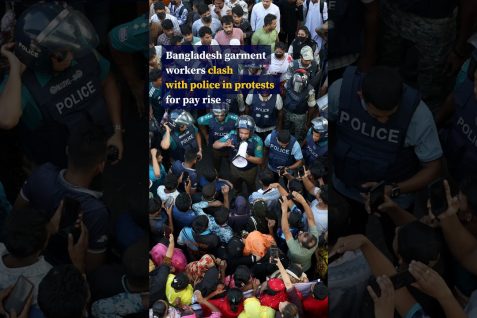
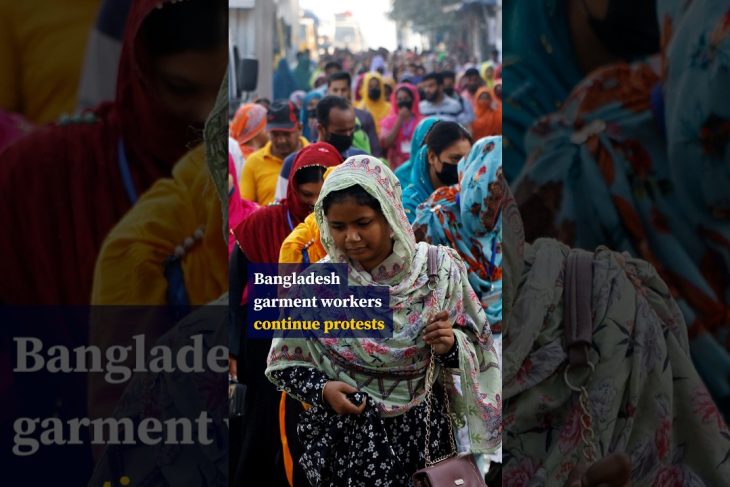
Thousands of Bangladeshi garment workers blocked highways and clashed with police on Sunday and Monday. The workers are demanding a 30,000 taka monthly wage (US$241), more than double their current pay. The protests came despite a government announcement on Sunday to establish a wage board to review the minimum wage in the country’s garment industry, which employs millions of people and generates the bulk of Bangladesh’s export earnings.
Thousands of garment workers across Bangladesh’s industrial belt have spent four days on the streets, blocking highways and facing tear gas and water cannon in the country’s most serious labour unrest in years. The workers are demanding a minimum monthly wage of 30,000 taka, about 245 US dollars, which is more than double the current minimum of 12,500 taka. The protests began on Saturday in Ashulia, a major garment manufacturing hub on the outskirts of Dhaka, and quickly spread to Gazipur and the capital itself. On Sunday the government announced it was setting up a wage board to review pay, but the announcement did not calm the streets. According to the Bangladesh Garment Manufacturers and Exporters Association, the unrest forced 529 factories to shut down, leaving 987,190 workers temporarily out of work across the main industrial hubs.
The Pay Packet That No Longer Covers Life
For the workers on the roadblocks, the dispute is arithmetic rather than politics: the price of food, housing, transport and healthcare has risen sharply while their pay has stood still. The current minimum of 12,500 taka was set in 2023, when it already represented a hard-fought compromise between unions and factory owners. Since then, persistent inflation has steadily eaten away at its real value, and workers say a month’s wages no longer cover a family’s basic needs. Much of the garment workforce is made up of women whose earnings support entire households, often including remittances to villages far from the factory districts. Union leaders argue that 30,000 taka is not a windfall but a survival figure, the minimum at which a worker can eat adequately, pay rent near the factories and still send something home. Factory owners counter that their margins are squeezed by the global brands that buy the clothes, and that a sudden doubling of wages would push orders to cheaper countries.
Roadblocks, Tear Gas and Shuttered Factories
The confrontation turned violent as demonstrators blocked a busy intersection in Dhaka and threw bricks at police, who responded with tear gas and water cannon. A police vehicle and a police box were set on fire in separate incidents as the clashes spread. In Gazipur, hundreds of workers blocked a major highway, disrupting transport through one of the country’s key industrial belts, and authorities deployed Border Guard Bangladesh personnel to help keep order. Gazipur’s industrial police said owners there shut 25 to 30 factories as the protests rolled on, on top of the dozens that had already suspended operations in Ashulia on Saturday. By Tuesday the protests had entered a fourth day, with police again firing tear gas to disperse demonstrators as unrest continued to disrupt factory operations and transport links.
A Wage Board, and a Race Against Patience
Labour and Employment Minister Ariful Haque Choudhury said the six-member wage board was formed after discussions with workers’ representatives and industry leaders, and he urged employees to return to work. The board is balanced by design, with two representatives each from workers and employers, alongside a government representative and a neutral member. Its task is to review wages across the garment sector and recommend revised pay rates. Wage boards in Bangladesh have historically moved slowly, however, and previous rounds have taken months of negotiation before producing a figure. That history explains the scepticism on the streets: without a number and a date attached, many workers see the board as a device for cooling the protests rather than answering them, and the demonstrations have continued despite its creation.
Why the World Is Watching Bangladesh’s Factory Gates
The stakes extend far beyond Dhaka’s suburbs, because Bangladesh is the world’s second-largest apparel exporter after China. The garment industry employs millions of people and generates the bulk of the country’s export earnings, making it the backbone of the national economy. The clothes sewn in Ashulia and Gazipur fill the shelves of major retailers in Europe and North America, so a prolonged shutdown ripples quickly through global supply chains. For the government, the dispute is a balancing act between keeping Bangladesh competitive as a low-cost manufacturing hub and ensuring the workers who built that status can live on what they earn. Until the wage board produces a figure the streets will accept, both the sewing lines and the roadblocks are likely to remain a daily fact of life in the world’s garment workshop.
This is not the first time Bangladesh’s wage question has spilled into the streets, and the pattern is well established. The last minimum wage settlement, in 2023, followed weeks of protests and roadblocks before the figure of 12,500 taka was announced, below what unions had demanded then as well. International brands that source from Bangladesh routinely publish commitments on living wages, yet factory owners say the prices those brands pay per garment have barely moved in years. That squeeze, between Western pledges and Eastern price tags, is passed down the chain until it lands on the sewing floor. Resolving it, economists say, requires the brands, the owners and the government to move together, because no wage board in Dhaka can rewrite the economics of a five-dollar T-shirt on its own.
A growing interest among Hong Kong women in an anti-ageing injection containing human tissue has prompted a recent crackdown by health authorities, as the product, widely known in Chinese as the “cadaver skin jab”, has not been registered for use in the city.
This story has been updated to clarify that Singapore health authorities have not approved the product as a drug, and that it is listed only in a government self-declaration database.
CCTV footage captured a fleeing driver stopping to pay a highway toll during a police chase in Malaysia on Saturday. Police said the 25km (15.5 mile) chase began in a suburb of Kuala Lumpur when the driver refused to pull over after police spotted him using his phone. The 41-year-old tested positive for methamphetamine after he was eventually stopped and arrested, according to police.
CCTV footage captured a fleeing driver stopping to pay a highway toll during a police chase in Malaysia on Saturday. Police said the 25km (15.5 mile) chase began in a suburb of Kuala Lumpur when the driver refused to pull over after police spotted him using his phone. The 41-year-old tested positive for methamphetamine after he was eventually stopped and arrested, according to police.
Hong Kong police arrested a 61-year-old man on Monday for allegedly spiking the drink of Japanese DJ Mao Hamasaki at a Hong Kong nightclub Halloween event over the weekend. The incident incapacitated Hamasaki and left her hospitalised in intensive care. The man is being investigated for allegedly administering poison with intent to injure.
Hong Kong police arrested a 61-year-old man on Monday for allegedly spiking the drink of Japanese DJ Mao Hamasaki at a Hong Kong nightclub Halloween event over the weekend. The incident incapacitated Hamasaki and left her hospitalised in intensive care. The man is being investigated for allegedly administering poison with intent to injure.
Amid a prolonged wave of inflation, arcades in Japan’s suburbs are filling claw machines with staples like eggs, rice, and detergent. These destinations blend shopping with entertainment, giving families a fun, cost-effective way to get essentials.
Amid a prolonged wave of inflation, arcades in Japan’s suburbs are filling claw machines with staples like eggs, rice, and detergent. These destinations blend shopping with entertainment, giving families a fun, cost-effective way to get essentials.
Watch the full podcast!
Protests in democratic countries have become fertile ground for China to sow its seeds of communism. In this episode we discuss China’s influence in the French riots, CODEPINK’s role in shilling for China, and China influence in data center protests in the U.S.
Joining us today is Piero Tozzi. He’s the Senior Director for China Policy at America First Policy Institute.
Join our fight to expose the CCP at and get ALL the new full-length interviews!
And check out our other channel, China Uncensored:
China claims you’re free to criticize the Communist Party—but speaking out can come with serious consequences. From mass surveillance and online harassment to arbitrary detention and physical violence, here are four ways the CCP silences its critics—and why visiting China might be riskier than you think.
Operation Honey Pot: Paste this emoji 🍯 in your comment below.
Want to know what the CCP is REALLY afraid of? YOU! Join the China Uncensored 50 Cent Army!
North Korea staged a rocket and missile demonstration last Thursday, attended by the supreme leader, his wife and his daughter. The missile tests came a day after Seoul said Pyongyang had fired “around a dozen” short-range ballistic missiles off its east coast. It was not immediately clear whether the reported launches were linked to the demonstration.
North Korea staged a rocket and missile demonstration last Thursday, attended by the supreme leader, his wife and his daughter. The missile tests came a day after Seoul said Pyongyang had fired “around a dozen” short-range ballistic missiles off its east coast. It was not immediately clear whether the reported launches were linked to the demonstration.
A hit-and-run accident at a cross-boundary checkpoint in Hong Kong triggered a 10-hour manhunt as a black Lexus evaded officers during a chase, according to police. The driver struck a barrier gate on the Hong Kong-Zhuhai-Macau Bridge before fleeing the scene. He was later arrested.
A hit-and-run accident at a cross-boundary checkpoint in Hong Kong triggered a 10-hour manhunt as a black Lexus evaded officers during a chase, according to police. The driver struck a barrier gate on the Hong Kong-Zhuhai-Macau Bridge before fleeing the scene. He was later arrested.
A private jet bound for the Bahamas crashed next to a busy road in a residential area in Florida on Sunday, killing all 9 passengers on board. The plane came down less than 11km (7 miles) from US President Donald Trump’s Mar-a-Lago estate, and around an hour after Trump left Florida after spending Sunday at the property.
A private jet bound for the Bahamas crashed next to a busy road in a residential area in Florida on Sunday, killing all 9 passengers on board. The plane came down less than 11km (7 miles) from US President Donald Trump’s Mar-a-Lago estate, and around an hour after Trump left Florida after spending Sunday at the property.
A Japanese disc jockey known as DJ Mao has regained consciousness following an alleged drugging at a Hong Kong club early Sunday morning. The victim, Mao Hamasaki, was admitted to a hospital intensive care unit and tested positive for four types of drugs, according to her manager. An unknown man reportedly asked Hamasaki to DJ at a private event and gave her a glass of orange juice after she turned down the work offer.
A Japanese disc jockey known as DJ Mao has regained consciousness following an alleged drugging at a Hong Kong club early Sunday morning. The victim, Mao Hamasaki, was admitted to a hospital intensive care unit and tested positive for four types of drugs, according to her manager. An unknown man reportedly asked Hamasaki to DJ at a private event and gave her a glass of orange juice after she turned down the work offer.
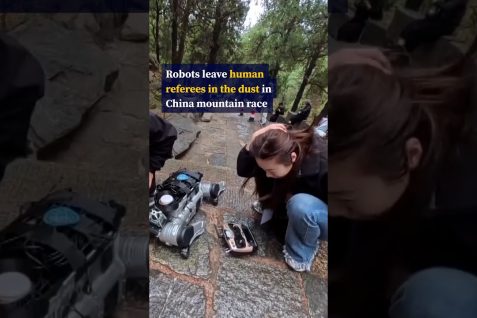
Referees at the first China Media Group (CMG) World Robot Mount Tai Climbing Competition had to draw up new rules to track robot athletes, as they had trouble keeping up with the machines.
The referees were supposed to follow each robot up the mountain, watch for rule-breaking and record the result at the top. Then the robots started climbing, and the humans could not keep up. At the qualifier for the first China Media Group World Robot Mount Tai Climbing Competition, officials discovered that their race plan assumed machines would move at a pace people could shadow on foot. On the stone steps of Mount Tai, that assumption fell apart within the first stretches of the course. The organisers did not slow the robots down. They rewrote how the race would be refereed.
Mount Tai, in Tai’an in eastern China’s Shandong province, is not a gentle test track. The competition course runs about 3.9 kilometres with roughly 3,100 stone steps and about 600 metres of climb, over continuous staircases, slopes and sharp turns. For centuries the mountain has been a pilgrimage site for emperors and a central place in Chinese mythology, and it is now a UNESCO World Heritage site. Sending robots up its ancient steps is both a sporting spectacle and a deliberately harsh engineering exam. Laboratory floors do not punish balance, perception and endurance the way wet, uneven, centuries-old stone does.
“Robots Run on Electricity, We Run on Food”
The problem was stated most plainly by Su Qingwei, chief referee for the final, after the qualifier exposed it. “Robots run on electricity, while we run on food,” Su said, explaining that a robot can swap its battery and keep accelerating while human stamina has clear limits. The original plan assigned a referee to follow each robot through the competition. On a short flat course that might have worked, but Mount Tai’s steps turn following into a race of its own. A referee who falls behind cannot judge what he cannot see, and a referee who tries to match a fresh-batteried machine risks becoming the event’s first casualty.
So the format changed from following to checkpoints. Instead of chasing the field, referees are now stationed at fixed points along the course, each responsible for a section of roughly 50 to 60 metres. In open stretches with good visibility a section can run longer, while at turns and blind corners officials must stand within sight of one another. When a robot approaches, the referee can step forward to meet it, observe it through his section and hand it on to the next pair of eyes. Su noted one comforting finding from the qualifier: there were very few rule violations to chase in the first place.
A Race Card Built to Test Real Work
The competition, held on November 2 with around 90 teams taking part, was never only about raw speed. Its official programme covered legged robot racing, legged robot load-bearing, all-terrain scouting and a humanoid robot race, with an exoskeleton assistance event in the wider programme. Those categories map onto the jobs people actually imagine for legged machines, from carrying supplies where wheels fail to scouting broken terrain after a disaster. In the load events the cargo was chosen to punish clumsiness, with machines hauling fragile goods such as fresh eggs and watermelons toward the summit. A fast robot that arrives with shattered cargo has demonstrated speed, not usefulness.
The results showed how quickly the field is moving, and how far it still has to go. A four-legged robot built by Beijing Lingyi Technology, a subsidiary of Unitree, won the four-legged speed category in 43 minutes and 41 seconds, a route state television noted takes most human tourists at least two hours. The fastest humanoid, from Beijing-based team Zhishen Lingyue, finished its shorter course in 27 minutes and 26 seconds. At the other end of the ledger, one humanoid wearing a bandana collapsed on the cobbled route and needed its engineers, another tumbled down stairs, and a Unitree G1 entry overheated mid-climb and was carried down on a stretcher. Triumph and slapstick shared the same staircase, which is usually a sign of a technology in honest transition.
Why a Mountain Race Matters Beyond the Spectacle
Events like this are China’s public way of stress-testing its embodied-intelligence industry in front of cameras. A robot that can climb 3,100 irregular steps has to solve perception, foothold planning, balance recovery, battery management and heat, all at once and all outdoors. Those are the same problems that decide whether legged robots can inspect mountain infrastructure, deliver supplies to remote sites or work in disaster zones where roads are gone. Holding the test on a famous sacred mountain also guarantees an audience that a warehouse trial would never attract. The spectacle is the point, and so is the failure footage, because both recruit talent and money into the field.
The most memorable outcome, though, happened before any medal was awarded. A sport invented for machines had to redesign its human officiating because the machines were already too fast over broken ground for people to follow. Checkpoint refereeing is a small administrative change, but it marks a quiet crossing point that sports from chess to motor racing have met before. When the competitors stop fitting the officials’ assumptions, the rulebook adapts to the machines, not the other way round. On Mount Tai, the robots did not just outrun the referees. They outran the original idea of how the race would be run.
NEW MANDARIN VERSION OF CHINA UNCENSORED!
Chinese parents are paying to send their kids to brutal “hardship camps” where they labor, farm, and break down crying. Sound familiar? It echoes the trauma of the Cultural Revolution—and Xi Jinping’s philosophy of learning to “eat bitterness.” Is China passing its trauma down to the next generation?
Operation Honey Pot: Paste this emoji 🍯 in your comment below.
Join the China Uncensored 50 Cent Army!
Despite having to use a wheelchair, Chen Tsz-kin has been embracing life in a way many other teenagers only dream about. Tsz-kin was diagnosed with Duchenne muscular dystrophy at the age of one and a half, and his family was told he had only about 18 years to live. Now, as he approaches this supposed deadline, Tsz-kin shares his views on life, death and why he dares to hope for a future.
Despite having to use a wheelchair, Chen Tsz-kin has been embracing life in a way many other teenagers only dream about. Tsz-kin was diagnosed with Duchenne muscular dystrophy at the age of one and a half, and his family was told he had only about 18 years to live. Now, as he approaches this supposed deadline, Tsz-kin shares his views on life, death and why he dares to hope for a future.
Australian mushroom murderer Erin Patterson lost her appeal on Friday against three murder convictions. Patterson poisoned her relatives with a beef Wellington laced with death cap mushrooms. A panel of judges rejected her grounds for appeal and increased her sentence, removing her chance of parole and ensuring she will spend the rest of her life in prison.
Erin Patterson went to court hoping to overturn her murder convictions, and she left it with a worse sentence than the one she arrived with. On Friday, October 30, 2026, Victoria’s Court of Appeal dismissed her appeal against three murder convictions and an attempted murder conviction arising from the poisoned beef Wellington lunch that horrified Australia. In the same ruling, the three judges accepted the prosecution’s argument that her original sentence had been too lenient. They set aside her life sentence with a 33-year non-parole period and replaced it with life imprisonment without parole. Patterson, who appeared by video link from prison and reportedly showed no emotion, will now die behind bars unless Australia’s High Court intervenes.
The Lunch That Killed Three People
The crimes date back to July 29, 2023, when Patterson hosted a lunch at her home in Leongatha, a small town in rural Victoria. Her guests were her estranged husband’s parents, Don and Gail Patterson, both aged 70, and Gail’s sister Heather Wilkinson, 66, along with Heather’s husband, Baptist pastor Ian Wilkinson. The beef Wellington Patterson served was laced with death cap mushrooms, among the most toxic fungi in the world. Don, Gail and Heather died in hospital in the days after the meal. Ian Wilkinson survived after weeks of intensive care, and his survival made him a central witness in what followed.
Patterson maintained from the beginning that the poisoning was a terrible accident. She told police the mushrooms came from an Asian grocery and a dehydrator she later disposed of, accounts that investigators systematically dismantled. Detectives arrested her at her home on November 2, 2023, after months of investigation that had already made the case an international sensation. The image of an ordinary family lunch turned into a triple killing drew global attention to a quiet corner of Gippsland. It also raised questions a jury would eventually have to answer about intent, planning and a trail of lies told in the aftermath.
A Trial, a Verdict and a Sentence With a Door Left Open
Patterson’s trial in 2025 ran for months and was followed around the world. Prosecutors argued that she had deliberately sought out death cap mushrooms, prepared individual beef Wellingtons so the poison reached only her guests, and invented stories afterwards to hide what she had done. The jury convicted her of three counts of murder and one count of attempted murder. In September 2025, Justice Christopher Beale sentenced her to life imprisonment. Crucially, he fixed a non-parole period of 33 years, describing her crimes as senseless but leaving open the possibility that she could one day apply for release.
That 33-year figure became the fault line for everything that happened next. Patterson’s lawyers moved to appeal the convictions, arguing she had suffered a miscarriage of justice. At the same time, the Director of Public Prosecutions appealed the sentence, arguing it was manifestly inadequate for offending of this gravity. Two appeals pointing in opposite directions were heard together by the Court of Appeal in August 2026. One side asked the court to free her; the other asked it to ensure she was never freed at all.
An Appeal That Failed on Every Ground
The appeal panel consisted of Justices Lesley Taylor, Stephen McLeish and Peter Kidd. Patterson’s legal team raised seven grounds against her convictions, and the court granted leave on the first two before ultimately rejecting all of them. Her arguments included a mix-up over hotel bookings that had placed jurors in the same accommodation as prosecutors, a key police witness and media during the trial. She also complained of an unfair and oppressive cross-examination lasting five days, claimed the prosecution shifted its theory of motive during closing arguments, and challenged decisions about evidence concerning her foraging, phone records and social media posts. The judges were unpersuaded on every point and found no miscarriage of justice.
Delivering the decision, Justice McLeish used language rarely heard even in murder appeals. He said Patterson’s offending was extraordinarily cold and calculated and stood to be denounced in the strongest terms. The court found that her murderous intent dated back to the invitations to lunch and persisted through the meal at which the poison was administered. On the prosecution’s appeal, the judges concluded that the case involved such calculated criminality that it was inappropriate to fix a non-parole period at all. The original sentence was set aside and replaced with life imprisonment with no possibility of parole.
Life With No Way Out
The ruling places Patterson in exceptionally rare company in Australian legal history. She is reported to be only the second woman in the country’s history to receive a life sentence without parole. The outcome is also a stark lesson in appellate risk: by challenging her convictions, she kept her case in a court that simultaneously held the power to harden her punishment, and the prosecution used exactly that opening. Her original sentence would have made her eligible to seek parole in her eighties. That possibility has now been extinguished entirely.
One narrow path remains. Patterson has 28 days from the ruling to seek special leave to appeal to the High Court of Australia, the country’s final court of appeal. The High Court accepts only a small fraction of such applications, and it does not grant a fresh hearing as of right. If leave is refused or no application is made, the Court of Appeal’s sentence stands as the final word. For the families of Don and Gail Patterson and Heather Wilkinson, the ruling closes a legal chapter that began with a family lunch more than three years ago. For Patterson, held at the Dame Phyllis Frost Centre women’s prison, it means the rest of her life will be spent inside.
Limited Time: Get your free Tank Man set when you join the 50-Cent Army:
Corruption in CNMI episode:
China’s AI stock bubble is bursting. The country’s AI and chip stocks have lost $480 billion in market value, and one hyped-up robotics company has seen its shares cut in half. After pushing citizens to invest in AI, the CCP may have just created another market crash.
Operation Honey Pot: Paste this emoji 🍯 in your comment below.
Want to go deeper than YouTube will let us? Check out our website:
The US midterm elections on November 3 will serve as a critical referendum on US President Donald Trump’s presidency as Democrats and Republicans battle for control of Congress and shape the political landscape heading into the 2028 presidential election.
While a divided government could lead to domestic gridlock, there are also international implications. SCMP’s US deputy bureau chief Mark Magnier breaks down why foreign policy, trade and relations with China might see dramatic shifts if the Republican administration faces unprecedented new constraints closer to home.
Japanese character company Sanrio has suspended current and future collaborations with the television drama Vivant after strong public criticism in China. The series, which follows a fictional secret intelligence unit in Japan, had scenes in its second season depicting a Chinese-linked intelligence agency torturing Japanese operatives.
Hello Kitty has been pulled out of a spy war. Sanrio, the Japanese company behind Hello Kitty, My Melody and Cinnamoroll, has terminated its collaboration with the hit television drama Vivant after a fierce backlash in China over scenes showing Chinese-linked agents torturing Japanese operatives. The company announced the decision late on Wednesday, October 28, apologised for the concern caused, and said the partnership contained elements inconsistent with its corporate values. All related merchandise has been taken off the market, and every future promotional activity tied to the drama has been cancelled. A collaboration built to put cute characters in spy costumes ended, within days, as a case study in how quickly entertainment becomes geopolitics in Asia’s biggest consumer market.
The speed of the reversal is part of the story. The Sanrio tie-up, launched in July for the drama’s second season, dressed its characters as Vivant’s covert operatives and was meant to be ordinary cross-promotion for a popular show. Instead, Chinese state media and social media users spent days attacking both the series and the brands attached to it. By the time a state-run newspaper warned that Hello Kitty should not dance with Japanese right-wing forces, Sanrio was facing a choice between a domestic television partnership and its standing in China. It chose China, publicly and completely, and promised to strengthen how it reviews collaborations from now on.
The Scenes That Started the Storm
Vivant is a spy thriller from Japanese broadcaster TBS, starring Masato Sakai and Hiroshi Abe, whose first season in 2023 followed a salaryman drawn into international espionage in a fictional Central Asian country. The second season, which premiered in July, introduced a fictional secret intelligence storyline in which a Chinese-linked agency captures members of a Japanese covert unit known as Beppan. In an episode aired on October 4, a Chinese agent is shown cutting off the fingers of a Japanese intelligence officer and stabbing him in the abdomen. Those images, clipped and shared online, became the centre of the controversy in China.
Chinese state broadcaster CCTV accused the series of something more specific than ordinary villain casting. It said the torture methods depicted bore striking similarities to atrocities inflicted on Chinese people by Imperial Japanese troops during Japan’s invasion of China, and accused the drama of distorting history by attributing those methods to modern Chinese characters. The Global Times, affiliated with the ruling Communist Party, echoed the charge, calling the portrayal a deliberate smear and an exaggeration of a so-called China threat theory. China’s foreign ministry added official weight, describing the drama as part of an effort to vilify and smear China that should concern the international community.
Sanrio’s Apology and the Values It Cited
Sanrio’s exit came through both its Chinese and Japanese arms. Sanrio Shanghai International Trading announced the cancellation on social media on October 28, and Sanrio in Japan followed with its own statement on October 29 apologising for any discomfort caused. The company said that since its founding it has used its characters to convey values such as care and connection, under a corporate philosophy summed up as one world, connecting smiles and fostering harmony among all people. Measured against that philosophy, it concluded, the Vivant collaboration did not belong in its portfolio, however successful the show itself might be.
The practical steps matched the language. As of October 29, all Sanrio Vivant items had been removed from sale, current collaboration activities were suspended and then terminated, and all related future plans and promotions were cancelled. Sanrio also said it takes the feedback it received very seriously and will strengthen its review processes for future collaborative projects. The apology did not satisfy everyone: the Global Times noted that some Chinese internet users demanded the same statement be published on Sanrio’s international channels, not only in China — a reminder that an apology aimed at one audience is now instantly read by every audience.
TBS Defends a Work of Fiction
The broadcaster behind Vivant has not followed Sanrio out the door. TBS president Masamine Ryuho said on Wednesday that the drama is completely fictional and was never intended to disparage any particular country. The network added that it will seriously consider questions about whether the show harbours hostility toward certain countries and features excessive violence. At the same time, TBS maintained that the torture scenes were necessary to the story it was telling, while saying it would continue to consider carefully whether depictions might cause discomfort or excessive fear among viewers.
That split response — a merchandise partner apologising and withdrawing, a broadcaster defending its fiction while promising reflection — captures the different exposures of the companies involved. TBS sells a drama to a primarily domestic audience and can frame the dispute as an artistic one. Sanrio sells characters whose entire value rests on being harmless, affectionate and welcome everywhere, including in shopping malls and theme partnerships across China. A torture controversy is an inconvenience for a spy series; for a brand built on smiles, it is a direct contradiction of the product itself.
Why China Matters Too Much to Risk
The commercial stakes explain the urgency. China is one of Sanrio’s most important growth markets, with Reuters reporting that its China sales rose almost 25 percent in the first quarter to about 9.8 billion yen, roughly $62 million, and other reporting putting its Chinese revenue growth even higher across the first half of the year. Hello Kitty and her fellow characters appear on everything from plush toys to licensed cafés in China, a business that depends on official goodwill and consumer affection alike. Against numbers like those, a single television tie-up in Japan was expendable, and Sanrio treated it that way.
The episode also lands in a wider, colder climate between Tokyo and Beijing. Relations have sunk to their lowest point in years, a deterioration dating from last November, when Japanese Prime Minister Sanae Takaichi suggested Japan would activate its Self-Defense Forces if China attacked Taiwan. In that atmosphere, a fictional torture scene does not stay fictional for long; it is read as a statement about real intentions, by real governments, with real markets attached. Sanrio is unlikely to be the last Japanese brand forced to choose which audience it can afford to offend — and its answer, delivered within days, shows how that calculation is usually made.
According to recently released financial results from the Volkswagen Group subsidiary, sales revenue fell 5.9 percent from a year earlier to 25.28 billion euros, or $28.19 billion, in the first nine months. Global vehicle deliveries fell 16 percent to 178,532. Operating profit, however, rose to 1.74 billion euros, or $1.94 billion, with a margin of 6.9 percent. A year earlier, profit was just 40 million euros, with a margin of 0.2 percent.
According to recently released financial results from the Volkswagen Group subsidiary, sales revenue fell 5.9 percent from a year earlier to 25.28 billion euros, or $28.19 billion, in the first nine months. Global vehicle deliveries fell 16 percent to 178,532. Operating profit, however, rose to 1.74 billion euros, or $1.94 billion, with a margin of 6.9 percent. A year earlier, profit was just 40 million euros, with a margin of 0.2 percent.
The controversy over the Kylian Mbappé meme continues to grow. Over the past two days, a Cultural Revolution-style campaign to erase Mbappé has been sweeping across China.
The controversy over the Kylian Mbappé meme continues to grow. Over the past two days, a Cultural Revolution-style campaign to erase Mbappé has been sweeping across China.
A game of table tennis – but despite the smiles, the stakes are high. German President Frank-Walter Steinmeier is visiting China at a time of growing economic and geopolitical tensions.
A game of table tennis – but despite the smiles, the stakes are high. German President Frank-Walter Steinmeier is visiting China at a time of growing economic and geopolitical tensions.
Hong Kong’s Chief Executive John Lee and other senior officials from his administration formally apologised for the city’s deadliest fire in decades at the beginning of a press conference on Thursday. Lee announced that housing secretary Winnie Ho was being held politically accountable for last November’s blaze at Wang Fuk Court in Tai Po, and that she had resigned on Wednesday. Lee then introduced a number of actions and reforms his administration would implement in response to a scathing report by an independent committee that investigated the Wang Fuk Court tragedy. The government received the report last week and released it to the public on Thursday.
Hong Kong’s Chief Executive John Lee and other senior officials from his administration formally apologised for the city’s deadliest fire in decades at the beginning of a press conference on Thursday. Lee announced that housing secretary Winnie Ho was being held politically accountable for last November’s blaze at Wang Fuk Court in Tai Po, and that she had resigned on Wednesday. Lee then introduced a number of actions and reforms his administration would implement in response to a scathing report by an independent committee that investigated the Wang Fuk Court tragedy. The government received the report last week and released it to the public on Thursday.
Watch the full podcast!
Canadian Prime Minister Mark Carney has made no secret of the fact he wants Canada to be less dependent on the United States. In doing so, he has cozied up to China, a move that tracks with his previous tenure as the head of the Bank of England.
Joining us today is Piero Tozzi. He’s the Senior Director for China Policy at America First Policy Institute.
Join our fight to expose the CCP at and get ALL the new full-length interviews!
And check out our other channel, China Uncensored:
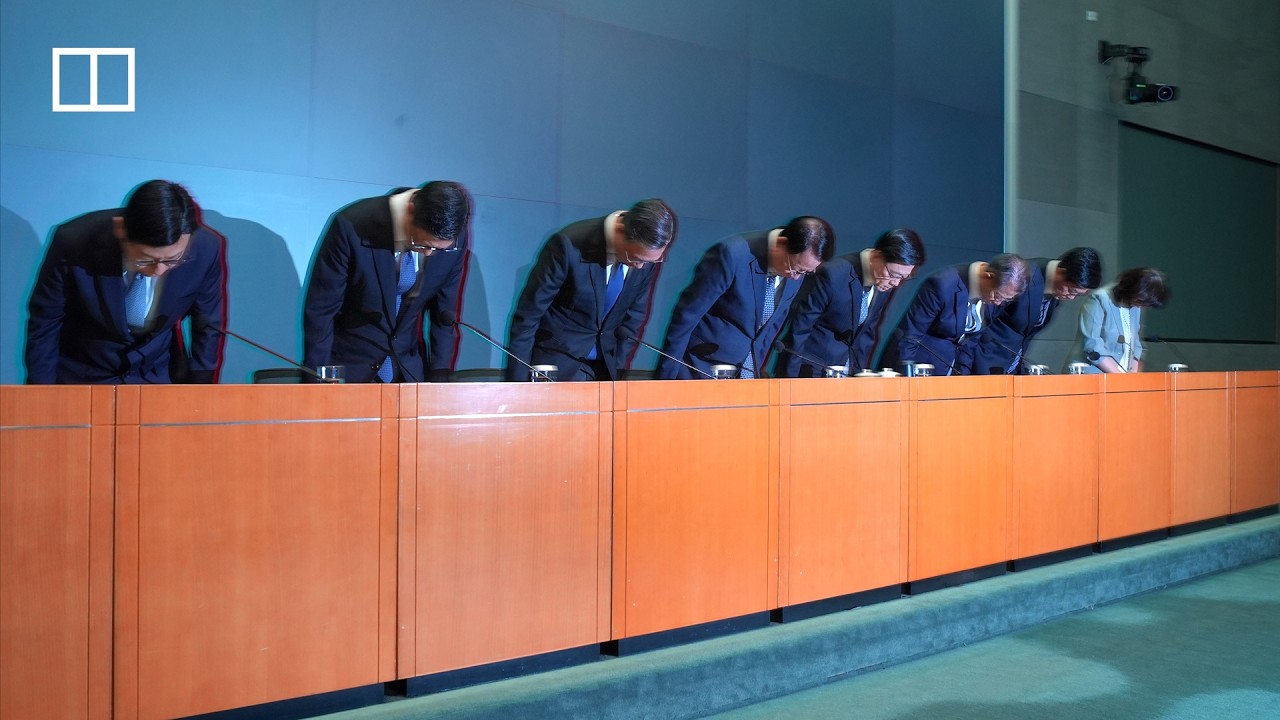
Hong Kong Chief Executive John Lee Ka-chiu and senior administration officials issued a formal apology on Thursday for the city’s deadliest fire in decades. Lee announced that secretary for housing Winnie Ho Wing-yin had stepped down on Wednesday after being held politically accountable for last November’s blaze at Wang Fuk Court in Tai Po. The city leader also unveiled a series of follow-up actions and systemic reforms to be implemented in response to a scathing report by an independent committee appointed to investigate the disaster.
Hong Kong’s leader stood before the cameras on Thursday, bowed alongside seven of his most senior officials, and apologised for the fire that killed 168 people — nearly a year after it happened. Chief Executive John Lee Ka-chiu used the release of a sweeping independent inquiry report into last November’s blaze at the Wang Fuk Court housing estate in Tai Po to announce the first political casualty of the disaster: Secretary for Housing Winnie Ho Wing-yin, who resigned on Wednesday after being held politically accountable for the failures the report describes. It was a rare scene of official contrition in Hong Kong, and it came only after a judge-led committee spent months picking apart how a renovation project on a subsidised housing estate turned into the city’s deadliest fire since 1948.
The fire broke out on November 26 last year at Wang Fuk Court, a government-subsidised estate of 31-storey towers that was in the middle of large-scale maintenance work, its buildings wrapped in scaffolding and protective netting. The flames ripped through seven of the estate’s eight towers, killing 168 people and displacing more than 4,600 residents, many of whom have spent the months since in temporary accommodation, waiting for answers. The committee’s answer, delivered in a report of more than 1,000 pages, is that the disaster was not simply a fire. It was a system failure, years in the making, in which warnings were raised, complaints were filed, and no one in authority took ownership of any of it.
A Bow, an Apology and a Resignation
“On behalf of the SAR government, I offer my apologies to the victims and the public at large,” Lee said, describing himself as deeply saddened as chief executive and head of the government. He said Ho should bear political responsibility for the disaster even though the inquiry found no personal wrongdoing on her part, and he confirmed that he had accepted her resignation, which took effect on Wednesday. Ho later issued a statement echoing that position. She is the first official to step down over the fire, and Lee signalled she may not be the last: the government is setting up an independent team to examine which officials should be held accountable and what disciplinary action should follow.
For many Wang Fuk Court residents and families of the dead, the apology arrived late. Critics have spent months accusing the government of moving too slowly on accountability, and the sight of the city’s leadership bowing in unison — a gesture of contrition more familiar from mainland China — was carefully calibrated to acknowledge that anger. Whether it satisfies the families will depend less on the bow than on what happens next: the disciplinary process, the criminal cases still moving through the courts, and the harder question of where thousands of displaced residents will ultimately live.
What the Inquiry Found
The committee, appointed by the government and led by a judge, examined more than a million files and heard testimony from 80 witnesses at hearings held between March and July. Its central finding is devastating in its simplicity: no government department took effective ownership of the fire safety issues at Wang Fuk Court, and complaints about hazards “fell into a vacuum.” Residents had raised safety concerns about the renovation work for more than a year before the fire, the report found, and those concerns went unheeded. The failings, in the committee’s words, were “systemic and pervasive.”
Four government bodies were held partially responsible, including the Housing Bureau’s independent checking unit, which the committee found had failed in its duty to supervise the maintenance work properly. The report concluded that the fire was most likely started by a “glowing source — likely a cigarette,” a small spark that became a catastrophe because of everything around it: flammable conditions on a scaffolded estate, oversight that existed on paper but not in practice, and a regulatory structure in which responsibility was so widely shared that, in the end, it belonged to no one. “The fire has been put out, but the reform has only just begun,” the report concluded.
The Companies at the Centre of the Case
While officials carry the political blame, the committee placed primary responsibility for the fire on two private firms: the contractor Prestige Construction & Engineering and the project consultant Will Power Architects. The inquiry described widespread unlawful and questionable practices in the building maintenance industry, including bid-rigging involving parties the report linked to organised crime. Its work runs alongside a separate criminal investigation in which at least 25 charges have been brought against the two companies and seven individuals, covering offences that include manslaughter, conspiracy to defraud, money laundering and tax evasion.
Prosecutors allege that the companies and some of the defendants conspired to defraud the estate’s owners by concealing the litigation history of the firm that was ultimately awarded the renovation contract — a deal worth more than 300 million Hong Kong dollars, over $38 million. For owners in estates like Wang Fuk Court, who are required by law to maintain their ageing buildings but depend entirely on contractors and consultants to do it honestly, the allegations describe a market that was rigged against them at every step. The criminal cases will decide individual guilt, but the committee’s verdict on the industry itself is already in, and it is scathing.
120 Recommendations — and a Promise to Criminalise Bid-Rigging
Lee promised swift but extensive reform, and put Chief Secretary Eric Chan in charge of a steering committee to drive it through. The inquiry made 120 recommendations, and the government’s headline response is a plan to criminalise bid-rigging across the construction industry, with proposed penalties of up to HK$10 million in fines and 10 years in prison. Alongside that, officials pledged to overhaul how renovation projects on housing estates are supervised, so that fire safety complaints land on a desk that is actually responsible for acting on them. It is, in effect, an admission that Hong Kong’s system for keeping its vast stock of ageing high-rises safe was built on trust — trust in contractors, trust in consultants, trust in paperwork — and that the trust was abused.
The stakes extend far beyond one estate in Tai Po. Hong Kong is one of the most densely built cities on earth, full of towers of exactly Wang Fuk Court’s vintage undergoing exactly the kind of maintenance work that preceded the fire, and every one of those projects now sits under a cloud of justified suspicion. The families of the 168 people who died cannot be given back what they lost in November. What they have been promised, at last and in public, is a government that owns its share of the blame — and a system rebuilt so that the next complaint about a dangerous building is answered before, not after, the fire.
Russia and China have been growing closer. Since Vladimir Putin annexed Crimea, Russia’s president has leaned on Beijing to fund the war in Ukraine and blunt the effect of Western sanctions. But their friendship has limits. The Economist’s Russia editor, Arkady Ostrovsky, explains why Russia may have become too dependent on China.
Watch the full show:
Sign up to the Insider newsletter:
In this episode of Pekingology, Senior Fellow Henrietta Levin is joined by Gerard DiPippo, Director for Global Macro at Eurasia Group. Henrietta and Gerard unpack the Chinese government’s ambitious techno-industrial policy. They discuss the AI race between the United States and China, why it sometimes seems like Beijing can draw on infinite resources to achieve its industrial objectives, whether technology can rescue China’s stalling economy, and how Chinese leaders are trying to minimize the country’s reliance on the rest of the world.
To learn more, you can read the recent RAND report from Gerard DiPippo, Jonathon Sine, and Benjamin Lenain: China’s Techno-Industrial Strategy in the Xi Era ( , as well as Gerard’s latest work with Eurasia Group.
In this episode of Pekingology, Senior Fellow Henrietta Levin is joined by Gerard DiPippo, Director for Global Macro at Eurasia Group. Henrietta and Gerard unpack the Chinese government's ambitious techno-industrial policy. They discuss the AI race between the United States and China, why it sometimes seems like Beijing can draw on infinite resources to achieve its industrial objectives, whether technology can rescue China's stalling economy, and how Chinese leaders are trying to minimize the country's reliance on the rest of the world.
To learn more, you can read the recent RAND report from Gerard DiPippo, Jonathon Sine, and Benjamin Lenain: China’s Techno-Industrial Strategy in the Xi Era ( , as well as Gerard's latest work with Eurasia Group.