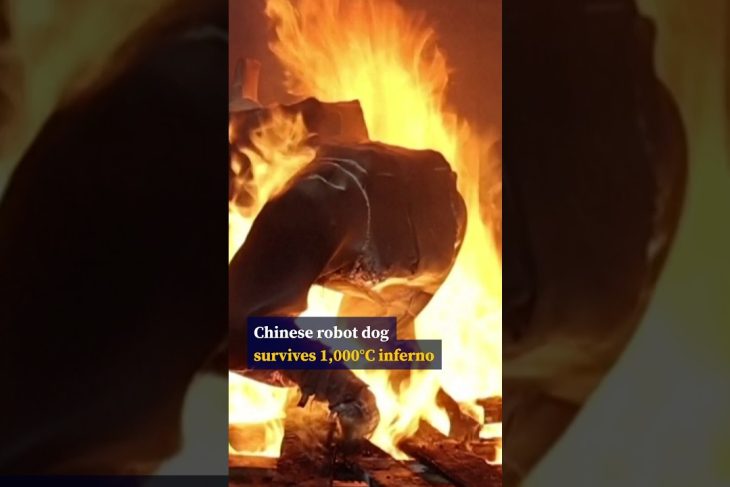
According to a report published Thursday by Science and Technology Daily, the robot dog wore an advanced suit made from a specialised fireproof composite material, allowing it to withstand heat of up to 1,000 degrees Celsius (1,832 Fahrenheit) without sustaining damage. The result is striking because it pushes a familiar four-legged robot into an environment that would destroy most machines in seconds. A robot that can walk into a burning building and keep working could change how firefighters search for survivors and how rescuers approach disasters that are still too dangerous for people.
The demonstration, reported in China, has drawn attention well beyond robotics circles because it combines two technologies that rarely meet: agile legged locomotion and extreme heat protection. Robot dogs are already used for inspection, surveillance and carrying equipment across rough ground, but heat has always been a hard limit on where they can go. A suit that survives 1,000 degrees Celsius would remove that limit in many fire scenarios, opening the door to machines that can scout ahead of human crews and report back from inside the inferno.
A Suit Built for 1,000 Degrees
The key to the feat is not the robot itself but the suit it wore, a specialised covering made from a fireproof composite material designed to shield the machine from intense heat. Ordinary plastics melt, metals soften and electronics fail long before temperatures reach 1,000 degrees Celsius, so the suit must insulate the robot’s body, joints and sensors while still allowing its legs to move freely. That balance between protection and mobility is the central engineering challenge, and the reported test suggests the designers have found a workable answer.
Composite materials are well suited to this job because they can combine layers with different properties, such as a heat-resistant outer skin and an insulating inner layer that slows the transfer of heat to the components beneath. The suit must also protect the robot’s cameras and sensors, which are essential if the machine is to see and navigate inside a fire, and it must do so without adding so much weight that the robot can no longer walk or climb. A successful design therefore has to solve thermal, mechanical and weight problems at the same time, which is why a test at 1,000 degrees is such a meaningful milestone.
How the Test Worked
As reported by Science and Technology Daily, the robot dog was exposed to heat of up to 1,000 degrees Celsius while wearing the fireproof suit, and it emerged without damage. The precise details of the test setup matter, because surviving a brief flash of heat is very different from enduring sustained exposure, and engineers will want to know how long the robot was in the heat, how the temperature was measured and which parts of the machine were checked afterwards. Even so, the headline result is clear: the suit kept the robot intact at a temperature at which most materials would fail.
Tests of this kind are usually staged in controlled conditions, with the robot placed in or near a furnace or a specially built fire chamber while researchers monitor its temperature, movement and systems. The goal is to prove the concept before the machine is ever sent into a real emergency, where conditions are unpredictable and failure could cost lives. If the robot can walk, turn and operate its sensors while wearing the suit in a controlled inferno, it has passed the first and most important test on the road to real-world use.
Why Firefighters Need Robots Like This
Firefighting is one of the most dangerous jobs in the world, and the early minutes of a fire are often the most hazardous, when the layout of a building is unknown, visibility is near zero and the risk of flashover or collapse is highest. A robot dog that can enter a burning structure ahead of human crews could map the interior, locate trapped people and identify hazards such as gas leaks or weakened floors before anyone else has to go in. That information could help commanders decide where to send firefighters and where to keep them out.
Robots also offer a way to keep working in conditions where human endurance is limited by heat, smoke and the weight of breathing apparatus. A machine does not need to breathe, does not tire and can be sent back into a dangerous area again and again, as long as its protection holds. The same capability would be valuable after earthquakes, industrial accidents and chemical fires, where the danger may be invisible and the environment may remain hostile for hours. A heat-proof robot dog is therefore not a curiosity; it is a tool that could save the lives of both victims and rescuers.
What Comes Next for Rescue Robotics
A single successful test does not make a rescue robot, and the next steps will be harder than the demonstration itself. Engineers will need to show that the suit can survive repeated exposure, that the robot can still move, climb stairs and navigate debris while wearing it, and that its cameras, communications and batteries keep working in extreme heat. Real fires also bring smoke, water from hoses, falling debris and sudden changes in temperature, all of which must be handled before a fire service can trust the machine with lives.
There are also practical questions about cost, training and deployment, because a rescue robot is only useful if fire departments can afford it, maintain it and integrate it into the way they already work. Even so, the direction of travel is clear, and the reported 1,000-degree test is a strong signal that heat is no longer an absolute barrier for legged robots. As the technology matures, the robot dog that walked through an inferno in a laboratory may one day walk into a real fire, ahead of the firefighters, and bring back the information that helps everyone come home safely.
Source: South China Morning Post