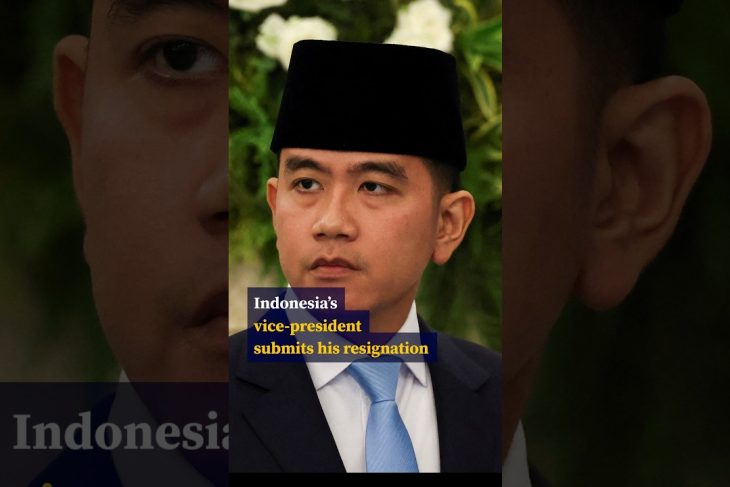
Indonesia’s vice-president, Gibran Rakabuming Raka, has resigned, stepping down roughly two years into his five-year term after court rulings destroyed the legal standing of the school qualification on which his candidacy rested. Gibran, 39, formally submitted his resignation to President Prabowo Subianto and to parliament, meeting leaders of the People’s Consultative Assembly, the MPR, at the parliament complex in Jakarta on Thursday, November 12, and asking that his resignation be processed. MPR Speaker Ahmad Muzani confirmed the meeting, which lasted about twenty minutes, and reports citing people familiar with the matter said Prabowo has accepted the resignation. The departure is unprecedented in modern Indonesian politics and leaves the world’s third-largest democracy to fill its second-highest office through a parliamentary vote rather than a national election. It also marks the dramatic unravelling of the political bargain that won the 2024 election, in which the son of the outgoing president joined the ticket of his father’s former rival.
A Diploma Dispute That Became a Constitutional Crisis
The crisis centres on a deceptively simple requirement: candidates for president and vice-president must have completed senior high school or an equivalent qualification. Gibran completed his secondary schooling in Singapore before earning a marketing degree there, and his candidacy relied on an official certificate treating that overseas education as equivalent to an Indonesian senior high school qualification. Last month, both the Constitutional Court and the Supreme Court ruled that the documents he submitted did not meet the election requirements. The Supreme Court went further, annulling the equivalence certificate and stating that no evidence was found to show Gibran had a foreign diploma or certificate that could serve as the basis for equivalency with a senior high school qualification. With that ruling, the legal foundation of his place on the 2024 ticket was, in the courts’ eyes, gone.
Gibran’s exit unfolded over three days rather than in a single announcement. On Tuesday, November 10, he met Prabowo at the Presidential Palace and offered to resign, saying he wanted to avoid a prolonged political fight, while also asking for the chance to prove the validity of his documents through the State Administrative Court. State Secretary Prasetyo Hadi initially told reporters the vice-president would continue working as usual, and the palace stressed that the government remained focused on its duties. On Wednesday, however, 120 lawmakers from eight political parties filed a petition with House leaders that formally started a parliamentary process capable of ending in impeachment, on the grounds that he no longer met the constitutional requirements for the office. Analysts noted that had Gibran not stepped down himself, an impeachment procedure would likely have been initiated after the House plenary meeting scheduled for Thursday, making his resignation on that same day a matter of hours rather than choice.
What Happens Next, and What It Does to Prabowo
Indonesia’s constitution provides an orderly, if unusual, answer to a vacant vice-presidency. Under Article 8, paragraph 2 of the 1945 Constitution, the People’s Consultative Assembly must hold a plenary session within sixty days to elect a new vice-president. The choice is tightly controlled by the palace: Prabowo, as president, has the sole prerogative to nominate the two candidates, and the assembly simply selects between them. Until that vote takes place, the office remains vacant and there is no new national election, a design meant to preserve the mandate of the winning ticket while replacing the individual who can no longer serve. The nomination decision will be read in Jakarta as a map of Prabowo’s alliances, because the successful candidate will owe the vice-presidency entirely to his sponsorship.
The deeper question is what the resignation does to the ruling alliance between Prabowo and former president Joko Widodo, universally known as Jokowi, whose eldest son Gibran is. Their partnership was always transactional: Jokowi delivered his enormous popularity and political machine to Prabowo’s 2024 campaign, and Gibran’s place on the ticket was the visible bond of that deal. Relations had already been strained by a growing rift between the two camps, tensions sharpened last week by the arrest of senior officials, including a Jokowi ally, over an alleged wiretapping plot targeting the president. In a gesture clearly aimed at containing the damage, Jokowi publicly pledged that his camp will keep supporting Prabowo’s administration, especially its programmes for the broader public, after his son’s resignation was handed in. Whether that pledge holds once the replacement nomination is made will decide whether this episode ends as a contained crisis or the opening of a longer power struggle.
A Government Already Under Street Pressure
Gibran did not fall in calm weather, and the diploma scandal landed on a government already losing public patience on several fronts at once. Thousands of protesters have taken to the streets across Indonesia in recent weeks demanding stronger action over months of forest and land fires, among the worst in a decade, which have choked communities in toxic haze and made thousands of people ill. The demonstrations have also targeted economic hardship, corruption and what critics describe as a drift toward authoritarianism under Prabowo’s government. Beyond the streets, the administration’s flagship free school meals programme is struggling to secure its funding, and the national stock market has been in crisis amid allegations of widespread market manipulation. Student demonstrations on Tuesday added education and environmental grievances to the same rolling protest movement.
Against that backdrop, the vice-president’s departure cuts both ways for Prabowo. It removes, quickly and constitutionally, a deputy whose eligibility had become a daily liability and a rallying point for the impeachment movement, and it does so before parliament could turn the process into a spectacle. At the same time, losing a vice-president two years into a term, over a qualification that should have been settled before the election, raises uncomfortable questions about the vetting inside the winning coalition and about the courts’ willingness to revisit that coalition’s mandate. The sixty-day clock now running toward the MPR vote gives Prabowo a controlled arena in which to reassert his authority and reward the allies he needs most. Indonesia has replaced a scandal with a selection process, and the name Prabowo puts forward will tell the country who really holds power in Jakarta now.
Source: South China Morning Post