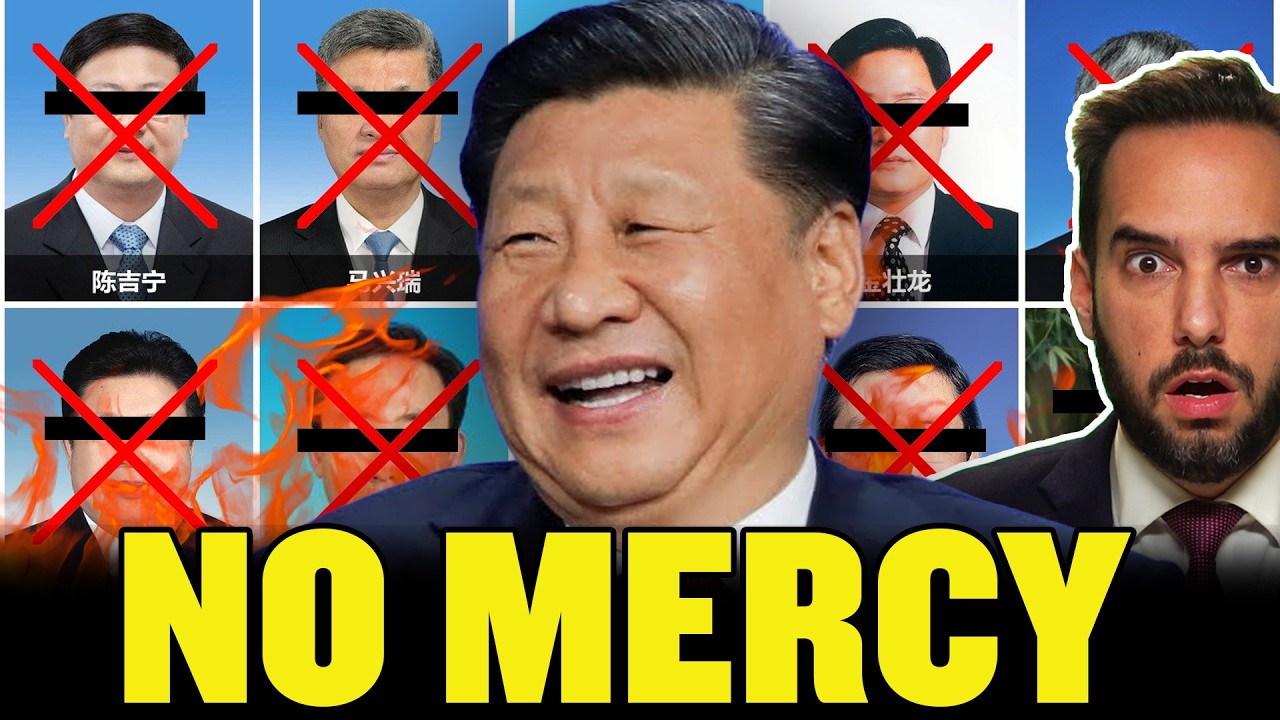
To understand the significance of the sweeping military purges in China and how Beijing is reacting to America’s war with Iran, I’m sitting down with eminent China scholar Robert Suettinger, a former CIA and State Department intelligence analyst, a senior advisor at The Stimson Center, and author of “The Conscience of the Party: Hu Yaobang, China’s Communist Reformer.” “There’s no question of the fact that Xi Jinping is now less of a dominant leader than he was six or eight months ago,” Suettinger says. Earlier this year, Xi purged two top generals from the CCP’s military brass, on the heels of earlier purges last year. Now, only two of the originally seven members of the Central Military Commission remain. One of them is Xi himself; the other one, General Zhang Shengmin, is a political commander and has, like Xi, no combat experience. After the January purges, Xi issued an order to the military demanding that everyone acknowledge him as the head of the military commission. “The silence from all those military commands has been deafening and has been noticed by everybody,” Suettinger says. In the Chinese Communist Party itself, Xi is also facing trouble. The CCP is not a monolithic party, he told me, but a complex entity with many competing factions: “There’s a Shanghai group, there’s a Shandong group, there’s a Shaanxi group, and they all don’t like each other,” Suettinger says. Suettinger believes that Xi’s many purges have unified opposition against him not only in the military but also within the Communist Party. “Xi is hated by almost everybody in China,” he said.
Source: Former CIA Analyst Explains Cracks in the Chinese System | Robert Suettinger
Summary
Former CIA analyst Robert Suettinger discusses significant internal challenges facing the Chinese Communist Party in a recent interview with American Thought Leaders. The conversation highlights a shift in power dynamics, noting that President Xi Jinping appears less dominant than he was several months ago following a series of military purges. These actions have left only two members of the Central Military Commission, neither of whom possesses combat experience, while creating widespread silence and potential opposition within the armed forces.
Suettinger describes the party not as a unified entity but as a complex group of competing factions that are increasingly united in their dislike for current leadership. Economic difficulties further exacerbate these tensions, with millions living below the poverty line and facing disappearing wealth opportunities. The interview suggests that the system is becoming brittle and unpredictable when it fails. Additionally, Beijing's reliance on Iran as a strategic distraction is diminishing as the United States effectively neutralizes this proxy relationship. The discussion concludes by examining the fragility of the totalitarian structure and historical visions for reform that have seemingly stalled under current conditions.
Watch “Former CIA Analyst Explains Cracks in the Chinese System | Robert Suettinger” on YouTube