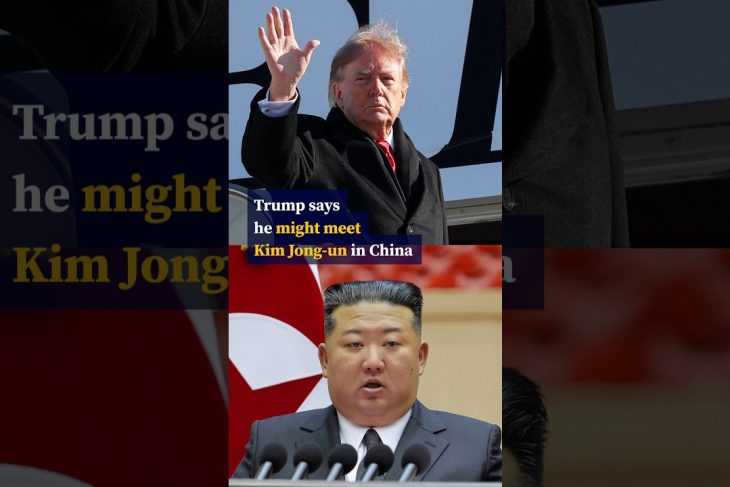
US President Donald Trump has raised the possibility of meeting North Korean leader Kim Jong-un in China this week, on the sidelines of the Asia-Pacific Economic Cooperation summit in Shenzhen. Trump said on Monday that any meeting with Kim would take place in China, and he placed the decision largely in the hands of the Chinese host. “(Xi) was here, and we’re also going to meet with (Russian) President Putin, and we may meet with Kim Jong-un also,” Trump said. “He may come. I don’t know. That’s up to President Xi.” The South China Morning Post reported the remarks as Trump travelled to Shenzhen for the APEC leaders’ meeting, which runs on November 18 and 19.
A Kremlin Comment That Moved the Odds
The speculation gained force on Tuesday after Russia’s Interfax news agency quoted the Kremlin on a possible meeting between Kim and Russian President Vladimir Putin. Kremlin spokesman Dmitry Peskov said Putin could meet Kim, adding: “Of course, if he is at the APEC summit.” Analysts told Reuters that the Kremlin comment shifted expectations, because Moscow would be unlikely to float such a meeting publicly without some confidence behind it. Sydney Seiler, a former US national intelligence officer for North Korea now at the Center for Strategic and International Studies, said the Kremlin “wouldn’t do that unless they were certain he was going to meet.” John Delury, a professor at the Hopkins-Nanjing Center, put it more bluntly: “If Kim goes to Shenzhen, he’s going to talk to Donald Trump.”
Trump, Xi Jinping and Putin are already scheduled to meet on Thursday in Shenzhen on the sidelines of the summit, in what would be the first summit ever held among the leaders of the three countries, with Beijing confirming that meeting on Monday. Adding Kim to that gathering would turn an already historic week of diplomacy into something without precedent. North Korea is not an APEC member, so Kim would attend as a guest rather than as a summit participant in his own right. His presence would also put four leaders with nuclear arsenals, or nuclear ambitions at the centre of their security policies, in the same city at the same time. That is precisely why officials are being careful not to confirm anything before it is certain.
Plenty of Reasons for Caution
Against the rising speculation stand several hard facts, and they deserve equal weight in any honest account of this story. US and South Korean officials had previously said the chances of a Trump-Kim meeting were low, and South Korea’s foreign ministry told local media on Tuesday that it still viewed the possibility as low. China’s foreign ministry, asked on Tuesday whether Kim had been invited to the APEC summit, said it had no information to share. The APEC secretariat likewise said it had no information about China and its guests, and neither China’s foreign ministry, the North Korean embassy in Beijing nor APEC immediately responded to Reuters requests for comment. Reuters also reported that there is little sign that China is making preparations for Kim to travel, which would normally be visible well before a visit of this sensitivity.
Kim Jong-un also travels rarely, and every foreign trip he takes is choreographed for maximum security and maximum symbolism. A journey to Shenzhen would be his most consequential outing in years, placing him alongside the leaders of China, Russia and the United States in a single frame. For Beijing, hosting such a gathering would underline its claim to be the indispensable broker in Northeast Asian security. For Moscow, a Putin-Kim meeting on Chinese soil would showcase the partnership the two countries have built since Russia’s full-scale war in Ukraine began. For Trump, a handshake with Kim would revive the most theatrical strand of diplomacy from his first term, whether or not it produced any agreement.
What a Meeting Could — and Could Not — Do
Trump and Kim met three times during Trump’s first presidency, and those encounters remain the high-water mark of direct US-North Korea diplomacy. Their first summit, in Singapore in June 2018, produced a broad statement on denuclearisation and new relations but no detailed commitments. A second summit, in Hanoi in February 2019, ended early without a deal, after the two sides failed to agree on sanctions relief and nuclear steps. A brief third meeting at the demilitarised zone in June 2019 restarted talks symbolically, but working-level negotiations never recovered, and no agreement followed. Since then North Korea has expanded its nuclear and missile programmes and deepened its ties with Russia, which makes any new meeting a very different negotiation from the ones of 2018 and 2019.
That record is why experienced Korea watchers separate the theatre of a meeting from the substance of one. A handshake in Shenzhen would dominate headlines worldwide and would signal that the door to diplomacy is not closed, and that alone would matter to Seoul, Tokyo and every capital watching the peninsula. It would not, by itself, roll back a single North Korean warhead, reopen inspections, or settle the sanctions that have accumulated over years of missile tests. The most a first encounter could realistically produce is an agreement to talk again, possibly with working-level teams and a defined agenda. Even that modest outcome would require preparation that, on the public evidence available on Tuesday, has not visibly taken place.
For South Korea, the stakes are immediate and practical rather than theatrical. Seoul has the most to gain from any easing of tensions on the peninsula, and the most to lose if it is cut out of a conversation about its own security. Its foreign ministry’s insistence that the chances remain low may reflect genuine information, a wish to lower expectations, or both at once. Japan, which lives within range of North Korean missiles, would also watch a Shenzhen meeting closely for any sign of what it means for regional deterrence. The coming days will settle the question one way or the other, because Kim either appears in Shenzhen or he does not.
As of Tuesday, then, the accurate summary is a narrow one: Trump has said a meeting might happen in China, the Kremlin has said a Putin-Kim meeting is possible if Kim attends, and analysts say those two comments together have raised the odds. No government has confirmed that Kim is coming, China says it has no information to share, and South Korea still rates the chances as low. Previously mooted Trump-Kim meetings have repeatedly failed to take place, and this one may join that list by the end of the week. If Kim does walk into Shenzhen, however, the APEC summit will be remembered less for trade than for the most unexpected diplomatic photograph of the year.
Source: South China Morning Post