Watch the full podcast!
Protests in democratic countries have become fertile ground for China to sow its seeds of communism. In this episode we discuss China’s influence in the French riots, CODEPINK’s role in shilling for China, and China influence in data center protests in the U.S.
Joining us today is Piero Tozzi. He’s the Senior Director for China Policy at America First Policy Institute.
Join our fight to expose the CCP at and get ALL the new full-length interviews!
And check out our other channel, China Uncensored:
China claims you’re free to criticize the Communist Party—but speaking out can come with serious consequences. From mass surveillance and online harassment to arbitrary detention and physical violence, here are four ways the CCP silences its critics—and why visiting China might be riskier than you think.
Operation Honey Pot: Paste this emoji 🍯 in your comment below.
Want to know what the CCP is REALLY afraid of? YOU! Join the China Uncensored 50 Cent Army!
North Korea staged a rocket and missile demonstration last Thursday, attended by the supreme leader, his wife and his daughter. The missile tests came a day after Seoul said Pyongyang had fired “around a dozen” short-range ballistic missiles off its east coast. It was not immediately clear whether the reported launches were linked to the demonstration.
North Korea staged a rocket and missile demonstration last Thursday, attended by the supreme leader, his wife and his daughter. The missile tests came a day after Seoul said Pyongyang had fired “around a dozen” short-range ballistic missiles off its east coast. It was not immediately clear whether the reported launches were linked to the demonstration.
A hit-and-run accident at a cross-boundary checkpoint in Hong Kong triggered a 10-hour manhunt as a black Lexus evaded officers during a chase, according to police. The driver struck a barrier gate on the Hong Kong-Zhuhai-Macau Bridge before fleeing the scene. He was later arrested.
A hit-and-run accident at a cross-boundary checkpoint in Hong Kong triggered a 10-hour manhunt as a black Lexus evaded officers during a chase, according to police. The driver struck a barrier gate on the Hong Kong-Zhuhai-Macau Bridge before fleeing the scene. He was later arrested.
A private jet bound for the Bahamas crashed next to a busy road in a residential area in Florida on Sunday, killing all 9 passengers on board. The plane came down less than 11km (7 miles) from US President Donald Trump’s Mar-a-Lago estate, and around an hour after Trump left Florida after spending Sunday at the property.
A private jet bound for the Bahamas crashed next to a busy road in a residential area in Florida on Sunday, killing all 9 passengers on board. The plane came down less than 11km (7 miles) from US President Donald Trump’s Mar-a-Lago estate, and around an hour after Trump left Florida after spending Sunday at the property.
A Japanese disc jockey known as DJ Mao has regained consciousness following an alleged drugging at a Hong Kong club early Sunday morning. The victim, Mao Hamasaki, was admitted to a hospital intensive care unit and tested positive for four types of drugs, according to her manager. An unknown man reportedly asked Hamasaki to DJ at a private event and gave her a glass of orange juice after she turned down the work offer.
A Japanese disc jockey known as DJ Mao has regained consciousness following an alleged drugging at a Hong Kong club early Sunday morning. The victim, Mao Hamasaki, was admitted to a hospital intensive care unit and tested positive for four types of drugs, according to her manager. An unknown man reportedly asked Hamasaki to DJ at a private event and gave her a glass of orange juice after she turned down the work offer.
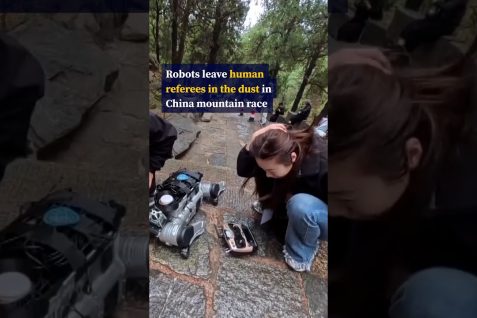
Referees at the first China Media Group (CMG) World Robot Mount Tai Climbing Competition had to draw up new rules to track robot athletes, as they had trouble keeping up with the machines.
The referees were supposed to follow each robot up the mountain, watch for rule-breaking and record the result at the top. Then the robots started climbing, and the humans could not keep up. At the qualifier for the first China Media Group World Robot Mount Tai Climbing Competition, officials discovered that their race plan assumed machines would move at a pace people could shadow on foot. On the stone steps of Mount Tai, that assumption fell apart within the first stretches of the course. The organisers did not slow the robots down. They rewrote how the race would be refereed.
Mount Tai, in Tai’an in eastern China’s Shandong province, is not a gentle test track. The competition course runs about 3.9 kilometres with roughly 3,100 stone steps and about 600 metres of climb, over continuous staircases, slopes and sharp turns. For centuries the mountain has been a pilgrimage site for emperors and a central place in Chinese mythology, and it is now a UNESCO World Heritage site. Sending robots up its ancient steps is both a sporting spectacle and a deliberately harsh engineering exam. Laboratory floors do not punish balance, perception and endurance the way wet, uneven, centuries-old stone does.
“Robots Run on Electricity, We Run on Food”
The problem was stated most plainly by Su Qingwei, chief referee for the final, after the qualifier exposed it. “Robots run on electricity, while we run on food,” Su said, explaining that a robot can swap its battery and keep accelerating while human stamina has clear limits. The original plan assigned a referee to follow each robot through the competition. On a short flat course that might have worked, but Mount Tai’s steps turn following into a race of its own. A referee who falls behind cannot judge what he cannot see, and a referee who tries to match a fresh-batteried machine risks becoming the event’s first casualty.
So the format changed from following to checkpoints. Instead of chasing the field, referees are now stationed at fixed points along the course, each responsible for a section of roughly 50 to 60 metres. In open stretches with good visibility a section can run longer, while at turns and blind corners officials must stand within sight of one another. When a robot approaches, the referee can step forward to meet it, observe it through his section and hand it on to the next pair of eyes. Su noted one comforting finding from the qualifier: there were very few rule violations to chase in the first place.
A Race Card Built to Test Real Work
The competition, held on November 2 with around 90 teams taking part, was never only about raw speed. Its official programme covered legged robot racing, legged robot load-bearing, all-terrain scouting and a humanoid robot race, with an exoskeleton assistance event in the wider programme. Those categories map onto the jobs people actually imagine for legged machines, from carrying supplies where wheels fail to scouting broken terrain after a disaster. In the load events the cargo was chosen to punish clumsiness, with machines hauling fragile goods such as fresh eggs and watermelons toward the summit. A fast robot that arrives with shattered cargo has demonstrated speed, not usefulness.
The results showed how quickly the field is moving, and how far it still has to go. A four-legged robot built by Beijing Lingyi Technology, a subsidiary of Unitree, won the four-legged speed category in 43 minutes and 41 seconds, a route state television noted takes most human tourists at least two hours. The fastest humanoid, from Beijing-based team Zhishen Lingyue, finished its shorter course in 27 minutes and 26 seconds. At the other end of the ledger, one humanoid wearing a bandana collapsed on the cobbled route and needed its engineers, another tumbled down stairs, and a Unitree G1 entry overheated mid-climb and was carried down on a stretcher. Triumph and slapstick shared the same staircase, which is usually a sign of a technology in honest transition.
Why a Mountain Race Matters Beyond the Spectacle
Events like this are China’s public way of stress-testing its embodied-intelligence industry in front of cameras. A robot that can climb 3,100 irregular steps has to solve perception, foothold planning, balance recovery, battery management and heat, all at once and all outdoors. Those are the same problems that decide whether legged robots can inspect mountain infrastructure, deliver supplies to remote sites or work in disaster zones where roads are gone. Holding the test on a famous sacred mountain also guarantees an audience that a warehouse trial would never attract. The spectacle is the point, and so is the failure footage, because both recruit talent and money into the field.
The most memorable outcome, though, happened before any medal was awarded. A sport invented for machines had to redesign its human officiating because the machines were already too fast over broken ground for people to follow. Checkpoint refereeing is a small administrative change, but it marks a quiet crossing point that sports from chess to motor racing have met before. When the competitors stop fitting the officials’ assumptions, the rulebook adapts to the machines, not the other way round. On Mount Tai, the robots did not just outrun the referees. They outran the original idea of how the race would be run.