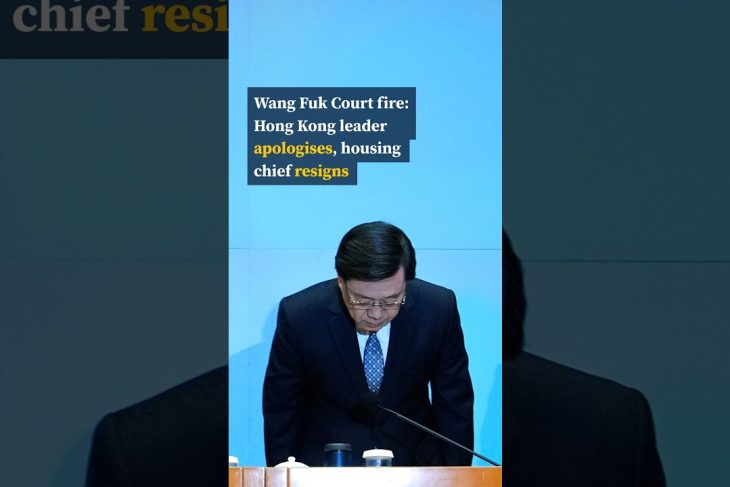
Hong Kong’s leader stood before the cameras on Thursday, bowed alongside seven of his most senior officials, and apologised for the fire that killed 168 people — nearly a year after it happened. Chief Executive John Lee Ka-chiu used the release of a sweeping independent inquiry report into last November’s blaze at the Wang Fuk Court housing estate in Tai Po to announce the first political casualty of the disaster: Secretary for Housing Winnie Ho Wing-yin, who resigned on Wednesday after being held politically accountable for the failures the report describes. It was a rare scene of official contrition in Hong Kong, and it came only after a judge-led committee spent months picking apart how a renovation project on a subsidised housing estate turned into the city’s deadliest fire since 1948.
The fire broke out on November 26 last year at Wang Fuk Court, a government-subsidised estate of 31-storey towers that was in the middle of large-scale maintenance work, its buildings wrapped in scaffolding and protective netting. The flames ripped through seven of the estate’s eight towers, killing 168 people and displacing more than 4,600 residents, many of whom have spent the months since in temporary accommodation, waiting for answers. The committee’s answer, delivered in a report of more than 1,000 pages, is that the disaster was not simply a fire. It was a system failure, years in the making, in which warnings were raised, complaints were filed, and no one in authority took ownership of any of it.
A Bow, an Apology and a Resignation
“On behalf of the SAR government, I offer my apologies to the victims and the public at large,” Lee said, describing himself as deeply saddened as chief executive and head of the government. He said Ho should bear political responsibility for the disaster even though the inquiry found no personal wrongdoing on her part, and he confirmed that he had accepted her resignation, which took effect on Wednesday. Ho later issued a statement echoing that position. She is the first official to step down over the fire, and Lee signalled she may not be the last: the government is setting up an independent team to examine which officials should be held accountable and what disciplinary action should follow.
For many Wang Fuk Court residents and families of the dead, the apology arrived late. Critics have spent months accusing the government of moving too slowly on accountability, and the sight of the city’s leadership bowing in unison — a gesture of contrition more familiar from mainland China — was carefully calibrated to acknowledge that anger. Whether it satisfies the families will depend less on the bow than on what happens next: the disciplinary process, the criminal cases still moving through the courts, and the harder question of where thousands of displaced residents will ultimately live.
What the Inquiry Found
The committee, appointed by the government and led by a judge, examined more than a million files and heard testimony from 80 witnesses at hearings held between March and July. Its central finding is devastating in its simplicity: no government department took effective ownership of the fire safety issues at Wang Fuk Court, and complaints about hazards “fell into a vacuum.” Residents had raised safety concerns about the renovation work for more than a year before the fire, the report found, and those concerns went unheeded. The failings, in the committee’s words, were “systemic and pervasive.”
Four government bodies were held partially responsible, including the Housing Bureau’s independent checking unit, which the committee found had failed in its duty to supervise the maintenance work properly. The report concluded that the fire was most likely started by a “glowing source — likely a cigarette,” a small spark that became a catastrophe because of everything around it: flammable conditions on a scaffolded estate, oversight that existed on paper but not in practice, and a regulatory structure in which responsibility was so widely shared that, in the end, it belonged to no one. “The fire has been put out, but the reform has only just begun,” the report concluded.
The Companies at the Centre of the Case
While officials carry the political blame, the committee placed primary responsibility for the fire on two private firms: the contractor Prestige Construction & Engineering and the project consultant Will Power Architects. The inquiry described widespread unlawful and questionable practices in the building maintenance industry, including bid-rigging involving parties the report linked to organised crime. Its work runs alongside a separate criminal investigation in which at least 25 charges have been brought against the two companies and seven individuals, covering offences that include manslaughter, conspiracy to defraud, money laundering and tax evasion.
Prosecutors allege that the companies and some of the defendants conspired to defraud the estate’s owners by concealing the litigation history of the firm that was ultimately awarded the renovation contract — a deal worth more than 300 million Hong Kong dollars, over $38 million. For owners in estates like Wang Fuk Court, who are required by law to maintain their ageing buildings but depend entirely on contractors and consultants to do it honestly, the allegations describe a market that was rigged against them at every step. The criminal cases will decide individual guilt, but the committee’s verdict on the industry itself is already in, and it is scathing.
120 Recommendations — and a Promise to Criminalise Bid-Rigging
Lee promised swift but extensive reform, and put Chief Secretary Eric Chan in charge of a steering committee to drive it through. The inquiry made 120 recommendations, and the government’s headline response is a plan to criminalise bid-rigging across the construction industry, with proposed penalties of up to HK$10 million in fines and 10 years in prison. Alongside that, officials pledged to overhaul how renovation projects on housing estates are supervised, so that fire safety complaints land on a desk that is actually responsible for acting on them. It is, in effect, an admission that Hong Kong’s system for keeping its vast stock of ageing high-rises safe was built on trust — trust in contractors, trust in consultants, trust in paperwork — and that the trust was abused.
The stakes extend far beyond one estate in Tai Po. Hong Kong is one of the most densely built cities on earth, full of towers of exactly Wang Fuk Court’s vintage undergoing exactly the kind of maintenance work that preceded the fire, and every one of those projects now sits under a cloud of justified suspicion. The families of the 168 people who died cannot be given back what they lost in November. What they have been promised, at last and in public, is a government that owns its share of the blame — and a system rebuilt so that the next complaint about a dangerous building is answered before, not after, the fire.
Source: South China Morning Post