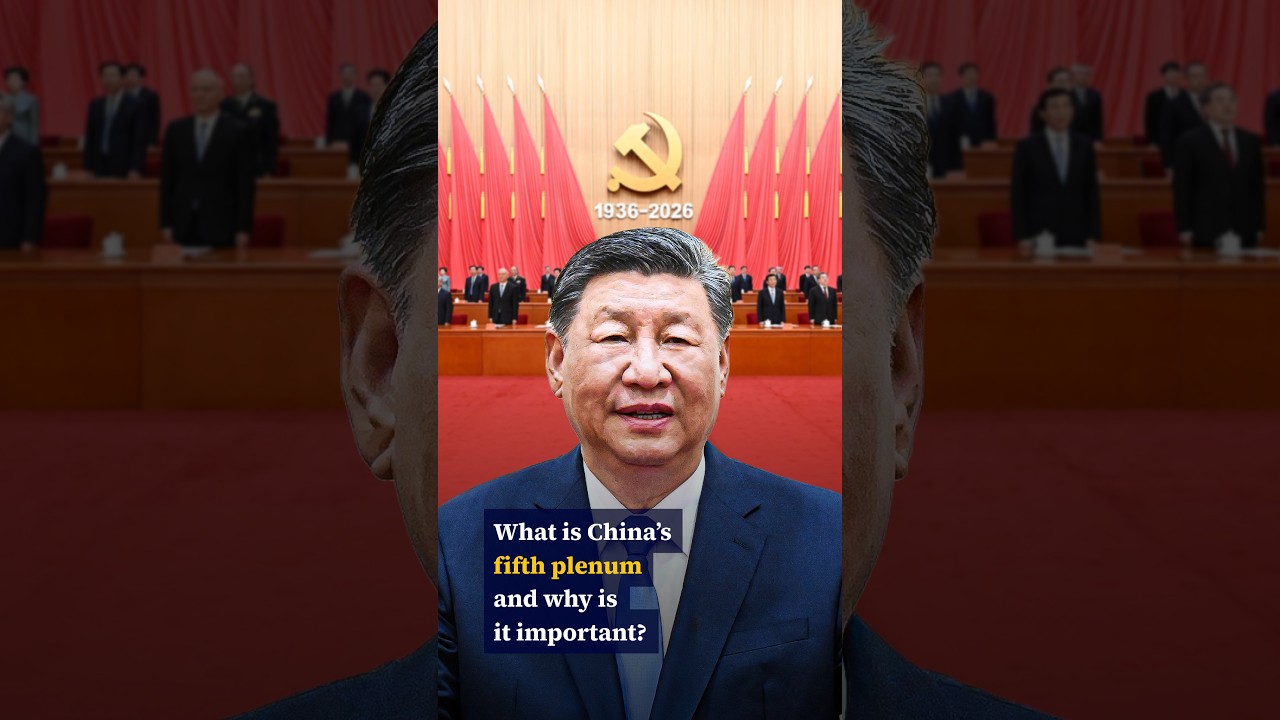
Behind closed doors in Beijing this week, roughly 300 of the most powerful people in China are holding one of the most consequential meetings of the political calendar. The fifth plenum of the Communist Party’s 20th Central Committee opened on Monday, October 26, and runs through Thursday, October 29. It is the fifth full gathering of the Central Committee elected at the 20th Party Congress in 2022. State news agency Xinhua announced the session months ago, back in July, but what happens inside it will shape the party that rules the world’s second-largest economy for years to come.
Unlike a parliament, the Central Committee does not debate in public or vote on camera. Its plenums are where the leadership aligns the vast party and state apparatus behind decisions that have usually been drafted in advance by the Politburo. The formal output is typically a short communique, expected when the session closes on Thursday, followed days later by a fuller decision document. For anyone trying to understand where China is heading — its economy, its military, its relations with Washington — these meetings are among the few fixed points where real signals are sent.
A Plenum About the Party Itself
The headline agenda this time is not the economy. According to Xinhua, the session’s main business is a draft decision on advancing “full and rigorous self-governance” of the party, alongside a work report from the Politburo. In plain terms, the meeting is about discipline: internal party governance, supervision of officials, political loyalty, and the rules that govern how cadres behave, spend, and advance. Xi Jinping personally briefed the opening session on the draft document, Xinhua reported. The emphasis, in the agency’s words, is that major decisions of the Central Committee “must not be empty rhetoric.”
That focus marks a change from the usual script. Fifth plenums have traditionally been where the party adopts recommendations for its next five-year economic plan. That work, however, was already done a year early: the fourth plenum, in October 2025, approved the recommendations for the 15th Five-Year Plan covering 2026 to 2030. With the economic framework settled, this session turns inward. The subject is the party’s own machinery — and whether it can be tightened further before the next leadership reshuffle.
The Anti-Corruption Campaign at the Center
Running through the agenda is Xi’s signature anti-corruption campaign, now well into its second decade. Since he took power, millions of people inside China’s bureaucracy have been investigated to varying degrees, and hundreds of senior officials and top generals have been purged — including figures once considered Xi’s own allies. The campaign has reached deep into the armed forces, where a string of senior officers has fallen in the past two years. The party portrays this as necessary renewal, describing a military that must be “forged anew.” Critics argue the purges are destabilizing and have thinned experienced command ranks.
The human arithmetic of the campaign is visible in this week’s attendance. Reporting by AFP, carried by CNA, counts eight Central Committee seats already vacant and another fifteen members under investigation and at risk of replacement. That is why analysts expect this plenum’s turnout to be the lowest at such a meeting since Mao Zedong died in 1976. A gathering meant to project unity and control will therefore also quietly document how far the discipline drive has cut into the party’s own top ranks. Expulsions and replacement appointments, if any are made, will be among the most closely read lines of Thursday’s communique.
One Year Before the Congress That Matters Most
The timing gives the plenum its deeper significance. In roughly a year, the party will hold its 21st National Congress, the once-every-five-years gathering at which the top leadership is formally selected. Xi is widely expected to seek a fourth term as general secretary, extending a rule that has already broken the post-Mao norm of two terms. A plenum devoted to discipline and loyalty, held twelve months before that congress, is a mechanism for clearing the field: aligning cadres, removing the compromised, and signaling that advancement runs through obedience to the center. Analysts describe this week’s session as possibly the last major party gathering before that 2027 reshuffle.
“The plenum will present Xi as in control, and able to continue his command,” Kerry Brown, director of the Lau China Institute at King’s College London, told Reuters ahead of the meeting. Brown added that appearances may matter as much as substance this week, with everything centered on Xi to dispel doubts about his authority. Xi himself set the tone days earlier, using a speech marking the 90th anniversary of the Long March victory on October 22 to call for sustained, strict party governance. The historical echo was deliberate: discipline, in that telling, is what carried the party through its hardest years.
What to Watch When the Communique Lands
For outside observers, the practical questions are narrow and specific. Does the communique announce expulsions of Central Committee members, and are alternate members promoted to fill the vacancies? How far do the new discipline rules reach — into officials’ spending, project approvals, and the military chain of command? Does the language on implementing central decisions hint at friction between Beijing and local governments, a recurring theme as the center presses provinces to execute policy exactly as written? And does anything in the document speak, even indirectly, to the succession positioning already under way for 2027?
Markets, too, will read the text closely, though for a different reason. A party visibly tightening discipline and enforcing predictable implementation can look, to investors, like a bid for policy consistency after years of abrupt regulatory turns. The fuller decision document, expected days after the communique, will carry the operational detail. Until then, the fifth plenum remains what it was designed to be: a room of 300 people deciding, in private, how the party of 100 million members will be run — and who will be running it when the congress convenes next year.
Source: South China Morning Post