Airlines have cancelled or rescheduled more than a dozen flights to and from Taiwan and Japan because of Super Typhoon Champi, with more disruption expected in the coming days. Now the strongest storm of the year worldwide, Champi made landfall in Taiwan on Friday. It is also affecting eastern mainland China and Japan.
Airlines have cancelled or rescheduled more than a dozen flights to and from Taiwan and Japan because of Super Typhoon Champi, with more disruption expected in the coming days. Now the strongest storm of the year worldwide, Champi made landfall in Taiwan on Friday. It is also affecting eastern mainland China and Japan.
More than 1,000 residents are expected to ride in autonomous vehicles (AVs) as Chinese tech giant Baidu launches Hong Kong’s first large-scale public trial.
More than 1,000 residents are expected to ride in autonomous vehicles (AVs) as Chinese tech giant Baidu launches Hong Kong’s first large-scale public trial.
At least 16 people were killed when a magnitude 7 earthquake struck China’s Tibet autonomous region late Thursday. According to the US Geological Survey, the quake’s epicentre was in a mountainous region around 190km (120 miles) east-northeast of Nagqu and 390km northeast of Lhasa, the regional capital. The People’s Liberation Army said it has deployed drones and hundreds of troops to assist with rescue efforts.
At least 16 people were killed when a magnitude 7 earthquake struck China’s Tibet autonomous region late Thursday. According to the US Geological Survey, the quake’s epicentre was in a mountainous region around 190km (120 miles) east-northeast of Nagqu and 390km northeast of Lhasa, the regional capital. The People’s Liberation Army said it has deployed drones and hundreds of troops to assist with rescue efforts.
Programming used to be one of China’s best-paid careers. With its concentration of tech companies, Beijing attracted large numbers of workers born in the 1990s. Now, a weak economy, intense competition, pay cuts, and layoffs are forcing many to leave and return home to make a living. Once well-paid office workers, they now face a new struggle to support themselves.
Programming used to be one of China’s best-paid careers. With its concentration of tech companies, Beijing attracted large numbers of workers born in the 1990s. Now, a weak economy, intense competition, pay cuts, and layoffs are forcing many to leave and return home to make a living. Once well-paid office workers, they now face a new struggle to support themselves.
As DeepSeek’s servers went down, “What happened to Liang Wenfeng?” also trended on Weibo. Online speculation ranged from him fleeing the country to being arrested. The rumors grew out of talk of a technical breakthrough at DeepSeek, spawning various theories about external security threats.
As DeepSeek’s servers went down, “What happened to Liang Wenfeng?” also trended on Weibo. Online speculation ranged from him fleeing the country to being arrested. The rumors grew out of talk of a technical breakthrough at DeepSeek, spawning various theories about external security threats.
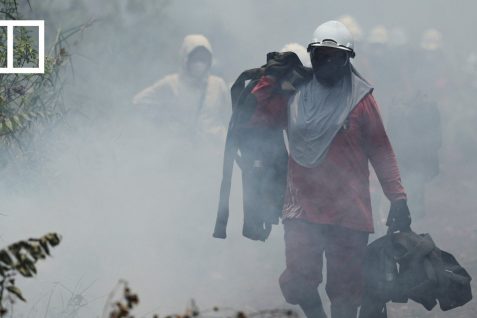
A group of all-female firefighters called the Power of Mama is rolling out on motorbikes to put out fires in Indonesia’s Ketapang Regency in West Kalimantan. The crew of more than 140 women received firefighting training from the Indonesia Nature Rehabilitation Initiative Foundation (YIARI).
They arrive on motorbikes, in a cloud of dust and smoke, carrying hoses, pumps, and hand tools into some of the most punishing terrain on Earth. The Power of Mama is an all-female firefighting crew working in Ketapang Regency, in Indonesia’s West Kalimantan province on the island of Borneo. More than 140 women have been trained for the work by the Indonesia Nature Rehabilitation Initiative Foundation, known as YIARI. Their enemy is not the dramatic wall of flame familiar from wildfire news elsewhere. It is a slower, stranger fire that burns underground in peat, sometimes for months, poisoning the air of an entire region.
Fire That Burns Beneath the Ground
Much of West Kalimantan sits on peatland, deep layers of partially decayed vegetation that hold enormous amounts of carbon and, when dry and drained, enormous fire risk. Peat fires do not rage so much as smoulder, creeping beneath the surface, surfacing where they choose, and resisting every attempt to declare them finished. Putting one out means soaking the ground itself, metre by metre, until the heat is truly gone, work that is measured in days rather than hours. A crew can drench a plot, leave, and be called back to the same smoking ground a week later. It is exhausting, unglamorous labour, and it is exactly the labour the Power of Mama was organised to do.
Why Mothers, and Why Motorbikes
The crew’s name is a statement of method as much as identity. In the villages around Ketapang, mothers are the organisers of daily life: they know every household, every path, and every patch of family land, and they are the first to feel a fire’s effects in children’s coughs and closed schools. Recruiting and training local women turns that knowledge into a fire service that outsiders cannot replicate. Motorbikes suit the reality of the work, carrying small teams quickly down narrow tracks to fires that trucks cannot reach in time. A fast first response matters enormously with peat, because a fire caught in its first hours may take a day to kill, while one left for a week can take a season.
A Crisis Measure in Hectares and Lungs
The context for their work is a national emergency that has been building for months. More than 1.9 million hectares of land, an area twelve times the size of London, have burned in wildfires across Indonesia this season. Hundreds of thousands of people in Indonesia and across Southeast Asia have suffered respiratory illnesses from the toxic haze the fires produce. The haze does not respect borders, drifting over neighbouring Malaysia and Singapore and periodically closing schools, grounding flights, and filling clinics far from any flame. Public anger has followed, with protests accusing authorities of ineptitude and corruption in handling a disaster that returns, in some form, almost every dry season. Against numbers like those, a village crew on motorbikes can look small, until you understand that nearly every hectare of that total started as a fire somebody could see from their house.
Prevention Is the Real Shift
The deeper change the Power of Mama represents is a move from response to prevention. Crews patrol during the dry season, watch for smoke, and work with farmers on the land-clearing practices that start so many fires, since burning remains the cheapest way to clear a field. A trusted local crew can make that argument in a way no distant agency can, because its members are neighbours rather than officials. YIARI’s training gives the women the technical side: pumps, hoses, fire behaviour, and safety in heat and smoke. The social side they bring themselves. A fire prevented leaves no headline, which is precisely the point, and precisely why prevention work is chronically undervalued until the haze arrives.
What Their Story Says About the Region
There is a reason this short film travels. Across Asia, the costs of environmental damage land first and hardest on rural women, who carry water, tend the sick, and keep households running when the air turns dangerous. The Power of Mama flips that script, putting the same women in the role of the region’s first responders, trained, equipped, and organised. It is also a reminder that Indonesia’s fire crisis will not be solved from Jakarta alone, or by aircraft and declarations during the worst weeks of smoke. It will be solved, if it is solved, in thousands of places like Ketapang, by people who live with the land and refuse to watch it burn. The women on the motorbikes are not waiting for that future. They are already riding into it, one smoking field at a time.
None of this work is easy on the body or the calendar. Peat smoke is thick with fine particles, the heat inside a smouldering field can defeat ordinary boots and gloves, and the fire season collides with the farming and family duties the women already carry. Shifts are arranged around school runs and harvests, which is another advantage of a local crew: it can flex in ways a posted-in unit cannot. The women describe the work plainly, as protection rather than adventure. They are defending their own children’s lungs, their own villages’ fields, and the forest their communities still depend on.
More than 1,000 residents are expected to ride in autonomous vehicles (AVs) as Chinese tech giant Baidu launches Hong Kong’s first large-scale public trial.
More than 1,000 residents are expected to ride in autonomous vehicles (AVs) as Chinese tech giant Baidu launches Hong Kong’s first large-scale public trial.
The grand finale of EQT Impact Challenge 2026 at Hong Kong’s M+ Museum in September saw some of Asia’s most promising deep-tech founders tackling challenges across climate and health.
The initiative, backed by global investment firm EQT and its philanthropic arm EQT Foundation, provides young companies with crucial early-stage investment alongside access to a global network of industry experts, investors and mentors.
After a seven-month journey that attracted more than 200 applicants and almost 6,000 public votes, five finalists took to the stage.
Advent Gene Therapeutics, which was named this year’s winner, has received investment of €500,000 (US$560,000) from EQT Foundation. The AI-driven biotech start-up develops next-generation viral vectors which enable safer, more precise and effective delivery of genetic medicines.
Okosix, which develops biopolymers that can reduce the use of plastic, and C2iTech, which hopes to use laboratory-grown cells to support the treatment of lung cancer , were named runners-up. They have both received support from Central Cove Group, the family office of Jean Eric Salata, chair of EQT Group.
SCMP Live of the South China Morning Post was an organising partner of EQT Impact Challenge 2026.
Malaysian police have arrested a 16-year-old student after he live-streamed an attack on a teacher with an axe at a private school in Kuching, the capital of Sarawak state.
Malaysian police have arrested a 16-year-old student after he live-streamed an attack on a teacher with an axe at a private school in Kuching, the capital of Sarawak state.